Acupuncture vs. Energy Healing: Acupuncture and Jnana Kanda
Acupuncture is a technique from traditional Chinese medicine in which trained practitioners insert thin needles at specific points on the body, guided by a framework of qi and meridians. Jnana Kanda is a separate Balinese energy practice, received through direct transmission (shaktipat) from a living Grandmaster, with no needles and no physical technique, and it rests on consent and on the relationship between body, energy and mind. Both are complementary approaches, neither replaces medical care, and the right choice depends on the person.
Acupuncture and energy healing are often placed in the same mental category because both mention "energy". In practice they are quite different. Acupuncture is a technique from traditional Chinese medicine (TCM): a trained practitioner inserts fine needles at specific points on the body. Jnana Kanda is a Balinese energy practice that uses no needles and no physical manipulation. It is based on a direct transmission of energy, called shaktipat, and on the idea that body, energy and mind form one connected field. This article describes each approach on its own terms and compares them fairly, without ranking one above the other.
I am Mathieu SUN, a practitioner and teacher of Jnana Kanda. I practise within one tradition and I am not an acupuncturist, so I describe acupuncture the way its own tradition and public research bodies describe it. If you are still weighing different options in general, you may also like What is the best energy-healing modality?
What is acupuncture and how does traditional Chinese medicine explain it?
Acupuncture is one of the best-known components of traditional Chinese medicine, a system of health care with a very long history in China and now practised in many countries. In a typical session, a practitioner inserts thin, sterile, single-use needles into the skin at selected points. Sometimes the needles are stimulated by hand, by gentle heat or with a small electrical current.
The TCM explanation rests on several core ideas:
- Qi (often written chi) is described as a vital life force that circulates through the body.
- Meridians are the pathways along which qi is said to flow. Acupuncture points are located along these channels.
- Health is understood as a balanced, smooth flow of qi, together with a balance between complementary forces often described as yin and yang.
- Diagnosis within TCM typically involves a detailed conversation about symptoms and lifestyle, and observation such as pulse and tongue assessment. The point selection is then adapted to the individual.
It helps to be clear about what kind of statements these are. Qi and meridians are concepts belonging to TCM's own framework. Biomedical science has not identified meridians as distinct anatomical structures, and qi is not something that current instruments measure. That does not make the tradition meaningless to those who practise it. It means that when we discuss qi we are describing a traditional model, not an established physiological fact.
Training and regulation vary widely by country. In some places acupuncturists are licensed health professionals with defined training standards, and in others the rules are different. If you consider acupuncture, it is reasonable to ask about a practitioner's qualifications, licensing and hygiene practices.
What does research say about acupuncture?
The U.S. National Center for Complementary and Integrative Health (NCCIH) offers a neutral overview of the evidence. In summary, it reports that acupuncture may help ease some types of chronic pain, such as low-back pain, neck pain and osteoarthritis of the knee, and may help prevent tension-type headaches and migraines. It also notes that evidence for many other conditions is limited or mixed, and that researchers are still studying how acupuncture might work.
NCCIH also notes that acupuncture is generally considered safe when it is performed by an experienced, well-trained practitioner using sterile needles. Serious complications are uncommon, but they can occur, especially with improperly sterilised needles or incorrect needling technique. Researchers continue to discuss how much of the observed benefit relates to needle placement itself and how much relates to other factors, such as expectation, attention and the therapeutic relationship. I mention this debate not to dismiss acupuncture but to show that the research picture is nuanced. You can read the NCCIH page directly in the sources below.
What is Jnana Kanda?
Jnana Kanda is a traditional Balinese energy practice, carried today as a living lineage by Grandmaster Mahaguru Mangku Alit Ajna. I trained with him and received shaktipat from him directly. If you would like the full overview, start with What is Jnana Kanda?. Here are the elements most relevant to this comparison.
Three dimensions. In the teaching, most human difficulties relate to three interconnected dimensions: the body (the physical, medical layer), energy (the vital force, which is not a medical category) and the mind (thoughts, emotions, beliefs, perception, identity). Energy is seen as the bridge between body and mind. The teaching says that imbalance often begins in subtler layers before it shows in the body, and that the influence runs both ways. A useful image is that the body is the vehicle, energy is the fuel and the mind is the driver.
A pure, intelligent energy that is received, not produced. According to the tradition, the heart of Jnana Kanda is a sacred, intelligent energy that knows where to go and is not limited by distance, time or physical boundaries. The practitioner does not create or control it. They are a vessel or channel through which it is received, allowed and transmitted. The teaching identifies its source as the Pendopo Agung, described as a higher energetic centre of purity. These are traditional teachings, not scientific claims.
Mind, heart and breath. After shaktipat, the practice is sustained by three aligned forces. The mind directs through clear intention free of doubt. The heart purifies through sincerity and compassion. The breath carries, being deep, calm and conscious. Jnana Kanda is described more as a state of being than as a technique, and there is no fixed posture. One may sit, stand or lie down, and the body follows the energy.
For more on how the practitioner's path begins, see Jnana Kanda initiation: melukat and shaktipat.
Do acupuncture and Jnana Kanda both work with energy?
Both traditions speak of a vital force and both consider health in terms broader than isolated symptoms. The Grandmaster's teaching notes that what other traditions call prana or qi corresponds to the vital-force layer it describes. Still, shared vocabulary should not be mistaken for shared practice. The origins, concepts, methods and training are different, and I think it is more respectful to each tradition to keep them distinct than to merge them into a single "energy medicine" category.
| Aspect | Acupuncture (TCM) | Jnana Kanda |
|---|---|---|
| Origin | Traditional Chinese medicine | Balinese tradition, carried today by a living Grandmaster |
| Central concept | Qi flowing through meridians; yin–yang balance | A pure, intelligent energy received and transmitted; body, energy and mind as one field |
| Method | Thin needles inserted at specific points, sometimes with heat or electrical stimulation | No needles and no physical technique; the practitioner acts as a vessel, with mind, heart and breath aligned |
| Who practises | Practitioners trained in acupuncture; licensing varies by country | Practitioners who have received shaktipat through the Grandmaster and follow the ethical path |
| Role of the practitioner | Assesses, selects points and applies the technique | Not the source of the energy; a channel, with no force or imposed outcome |
| Consent | Informed consent as in health care | The Law of Consent is central: no working on someone without their awareness and permission |
| Distance | The person is physically present for needling | Traditionally taught as not limited by distance, so online sessions are offered |
| Research status | Studied; NCCIH reports possible benefit for some chronic pain, with mixed evidence for other conditions | Traditional teaching; no scientific confirmation of its energetic claims |
| Relationship to medicine | Often used as a complementary approach alongside conventional care | Complementary; does not replace medical care |
How does a session feel and unfold in practice?
An acupuncture session usually begins with a conversation about your health history and symptoms. You then lie or sit comfortably while needles are placed, and they are often left in for a period of time. Many people describe the experience as relaxing, though sensations can vary. Appointments are commonly repeated over several weeks.
A Jnana Kanda session is quieter and less visible. We talk first about what you are experiencing and what you hope for. You then receive the session seated or lying down, in person or online, while I remain in the state of alignment I described earlier. Nothing is inserted and nothing is manipulated. The tradition says changes may be instant or progressive, subtle or more noticeable, and that none of this can be forced or promised. If you are curious about the online format, what happens in an online energy healing session describes it step by step.
What distinguishes Jnana Kanda?
Jnana Kanda does not try to add something artificial or force a result. It addresses what interferes with a person's natural coherence, such as stress, emotional burden, fear and mental noise, so that their own energy can flow more naturally. The tradition's view is that the body has its own intelligence for self-regulation, and that healing is something remembered rather than given. A person is not seen as fundamentally defective and does not need to become somebody else.
It is not about forcing the sun to shine. It is about allowing the flower to open. In practice, this means that I do not impose an outcome. The person's openness, readiness and willingness to receive matter, and the intention is the highest good of all.
Several foundations give the tradition its own character:
- Balinese water culture. In Bali, purification in living water (melukat) comes before transmission. Water is part of how the tradition understands cleansing and beginning anew.
- Permission and humility. Approaching nature, and another person, is compared to entering someone's home: you ask, you do not impose. This is the root of the Law of Consent.
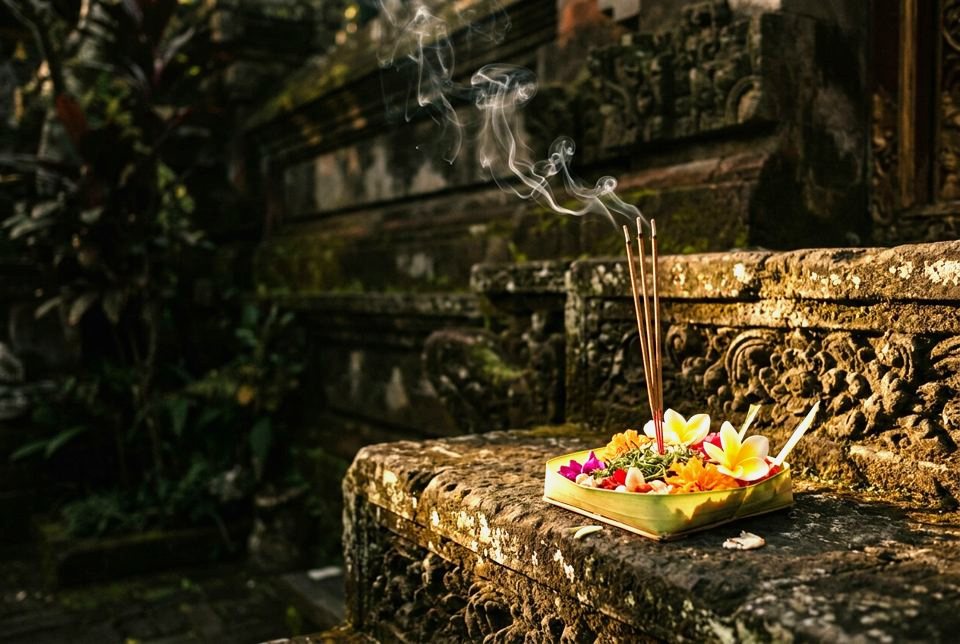
- Gratitude. Daily offerings such as canang sari, made of flowers, water, incense and similar elements, express respect and gratitude and ask permission of nature. They are part of the culture and are never a requirement for a session.
- Direct transmission. The ability is awakened through shaktipat from a living Grandmaster, with an emphasis on keeping the teaching pure and free of ego.
- The character of the practitioner. The teaching holds that the purity of the energy depends on the purity of the vessel. That means humility, discipline, sincerity, service without attachment and respect for the natural order of life.
If you want to know more about who is behind this work, Mathieu SUN, Jnana Kanda teacher explains my path.
Can acupuncture and Jnana Kanda be combined?
They are different practices with different purposes, and people sometimes explore more than one. I would offer three cautions. First, neither one replaces medical diagnosis or treatment. If you have a health concern, see a qualified healthcare professional. Second, let your doctor and any practitioner know about the other approaches you use, so that your care stays coherent. Third, give each approach a clear place in your life instead of expecting one to do everything. The Grandmaster's teaching is explicit on the balance: the wise path combines medical support, healthy living and deep awareness. Sleep, nutrition, movement, breathing, time in nature and emotional processing matter in every case.
For questions about boundaries and precautions, read Is Jnana Kanda safe?
Who might find Jnana Kanda relevant, and who might prefer acupuncture or another approach?
No modality is automatically best for everyone. The person matters as much as the method, and experiences vary.
Jnana Kanda may resonate with you if you are drawn to a subtle, non-invasive approach with no needles and no physical contact. It may also suit you if you see stress, emotions and the body as connected, if you value consent and a quiet, unforced atmosphere, or if you want to receive sessions online from home. It may also interest you if you are drawn to a living tradition with a cultural and ethical foundation, rather than a purely technical one.
Acupuncture may suit you better if you want a regulated, research-studied technique, especially for a specific type of pain for which NCCIH reports some supportive evidence. It may also suit you if you prefer a hands-on, structured treatment plan with a licensed practitioner, or if you are comfortable with needles and like the TCM way of understanding your health.
If you also wonder how other approaches compare, these articles take the same fair, side-by-side view: acupressure and energy healing, qigong and Jnana Kanda and massage and energy healing. For a comparison with another well-known practice, see energy healing vs. Reiki.
Frequently asked questions
Is acupuncture a type of energy healing?
In the TCM framework, acupuncture aims to influence the flow of qi, so it is often described as working with energy. But it is a needle-based technique performed by trained practitioners, with its own diagnostic system, and most people consider it a distinct discipline from transmission-based practices such as Jnana Kanda.
Does Jnana Kanda use needles, pressure points or meridians?
No. Jnana Kanda uses no needles and no pressure points, and it does not rely on the meridian model of TCM. It follows its own Balinese teaching: an intelligent energy that is received and transmitted by the practitioner as a vessel, within the framework of the body, energy and mind as one field.
Is there scientific evidence for acupuncture and for Jnana Kanda?
Acupuncture has been studied extensively, and NCCIH reports that it may help with some types of chronic pain, while evidence for other conditions is less clear. Jnana Kanda is a traditional spiritual practice, and its energetic teachings have not been scientifically confirmed. I present them as the tradition's perspective, not as established science.
Can I receive Jnana Kanda online if I usually go to an acupuncturist in person?
Yes. Acupuncture requires physical presence for needling, whereas the tradition teaches that Jnana Kanda is not limited by distance, so sessions with me can take place online or in person in Cap d'Antibes. Online sessions are a convenient complement for people who already see other practitioners.
Should I stop my acupuncture or medical care to try Jnana Kanda?
No. Jnana Kanda is complementary and works alongside medical care, not instead of it. Please continue any treatment recommended by your healthcare professionals and talk to them before making changes.
Discover Jnana Kanda with Mathieu SUN
If Jnana Kanda feels like it might fit what you are looking for, you are welcome to experience it first-hand by booking an online session with me. If you feel called to learn the practice yourself, the two-day in-person Jnana Kanda training is where transmission takes place. Jnana Kanda is a complementary practice for wellbeing and personal development. It is not a medical treatment and does not replace medical care, diagnosis or the advice of a qualified healthcare professional.
Sources and further reading
- Acupuncture: What You Need To Know (NCCIH) — a neutral overview of what research says about acupuncture's uses, evidence and safety.
- Acupuncture (Wikipedia) — background on the history, techniques and research discussion around acupuncture.
- Traditional Chinese medicine (Wikipedia) — context on the TCM framework in which acupuncture is practised.
- Qi (Wikipedia) — an explanation of the concept of qi in Chinese thought and medicine.
- Shaktipat (Wikipedia) — a general reference on the concept of energy transmission in South Asian traditions.