Massage vs. Energy Healing: Massage and Jnana Kanda Compared
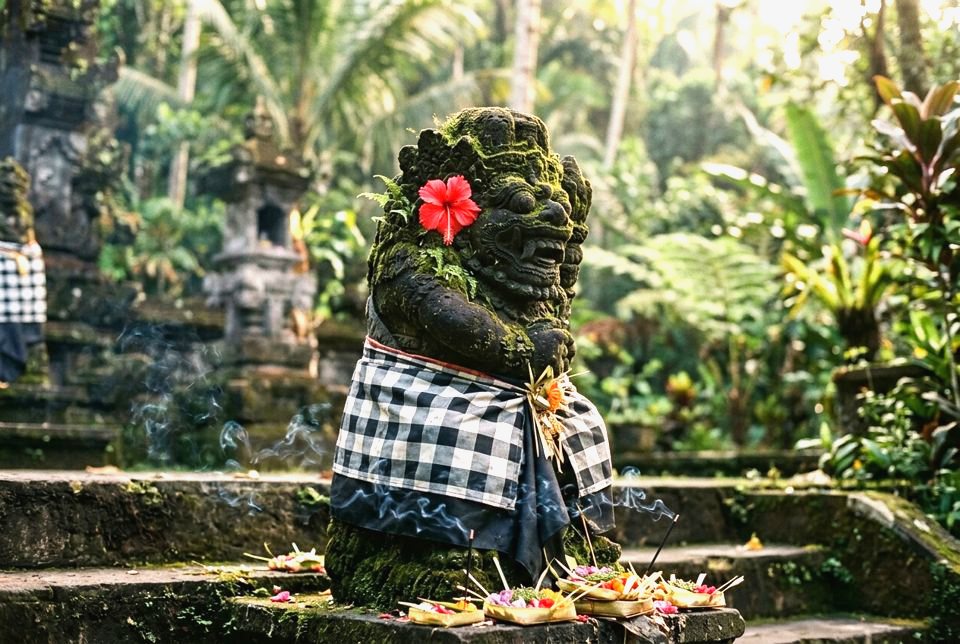
Massage is a hands-on practice in which a therapist manipulates muscles and other soft tissue, mainly to relax the body and ease physical tension. Jnana Kanda, a traditional Balinese energy practice, works from a different premise: it addresses the relationship between body, energy and mind, without physical manipulation and with the person's consent. They are not interchangeable. Massage is often the better choice for muscular tension, while Jnana Kanda may appeal to people drawn to an energetic and contemplative approach. Neither replaces medical care.
The difference between massage and energy healing starts with physical contact: massage relies on it, while Jnana Kanda is entirely touchless. Massage works directly on the body: a trained therapist uses their hands, and sometimes forearms or elbows, to knead, press and stretch muscles and other soft tissue. Jnana Kanda, a traditional Balinese energy practice, does not rely on physical manipulation. Its framework looks at the relationship between body, energy and mind, and it is practised with the person's awareness and consent. Both are complementary practices for wellbeing, and neither is a medical treatment.
This article explains each approach on its own terms, compares them fairly, and says plainly when massage is the better choice. It is written by the team behind mathieusun.com, where Mathieu SUN teaches and practises Jnana Kanda. That is a perspective, and you should read it as one. If you are comparing several approaches at once, our overview What is the best energy-healing modality? may help you step back and look at the bigger picture.
What is massage, and how does it work?
Massage is one of the oldest and most widely practised forms of hands-on care, found in many cultures in many forms. In its modern therapeutic sense, it means the manipulation of the body's soft tissues (muscles, tendons, ligaments, skin and connective tissue) through pressure, stroking, kneading and movement. Its physical nature is its defining feature: something tangible happens to the tissues, and you can usually feel it as it happens.
People seek massage for many reasons: to relax, to ease muscle tightness after a long week at a desk, to recover after sport, or simply to enjoy being cared for. Research on massage is a real and ongoing field. The U.S. National Center for Complementary and Integrative Health (NCCIH) summarises it on its massage therapy page, linked in the sources below. In general terms, studies suggest massage may help with certain kinds of pain and with feelings of stress or tension, though the quality and consistency of the evidence varies depending on the condition and the type of massage.
Common forms of massage
- Swedish massage: a classic Western style using long gliding strokes, kneading and circular movements, usually aimed at general relaxation.
- Deep tissue massage: slower strokes and firmer pressure intended to reach deeper layers of muscle and the surrounding connective tissue, often chosen for persistent tightness.
- Sports massage: techniques adapted to people who train regularly, used before or after activity or to address specific overworked areas.
- Thai massage: a traditional Thai approach in which the practitioner combines rhythmic compression with assisted stretching. It is usually received fully clothed, on a mat.
- Balinese massage: a style associated with Bali that is typically described as blending long strokes, kneading, gentle stretching and acupressure-type pressure, often with aromatic oils. Details differ from one practitioner or spa to another.
Notice what these forms have in common. Whatever the style, the mechanism is physical contact and mechanical work on the body. That is not a limitation; it is simply what massage is, and it is precisely why it is so well suited to some situations.
What is Jnana Kanda, and how is it different in principle?
Jnana Kanda is a traditional Balinese energy practice. Mathieu SUN trained with Grandmaster Mahaguru Mangku Alit Ajna, from whom he received direct transmission (shaktipat). The lineage is a living one, carried today by the Grandmaster. For a fuller introduction, see What is Jnana Kanda?.
According to the Jnana Kanda teaching, most human difficulties involve three interconnected dimensions: the body (the physical and medical), energy (the vital force, which other traditions call prana or qi) and the mind (thoughts, emotions, beliefs, perception, identity). These three are seen as a triangle that constantly influences itself. The tradition offers an image: the body is the vehicle, energy is the fuel, and the mind is the driver. Energy is considered the bridge between body and mind, so imbalance is said to often begin in subtler layers before it becomes visible in the body.
From this perspective, the body has its own inner intelligence and capacity to self-regulate. Stress, emotional burden and energetic disturbance are understood as interference with that intelligence. The practice is described as removing interference, such as fear, mental noise and emotional resistance, so the person's natural coherence can function. Healing is understood as something remembered rather than given.
It is important to be clear about the status of these ideas. They are the tradition's teachings, not established scientific findings. Science has not confirmed the existence of a measurable vital energy of the kind the tradition describes, and Jnana Kanda makes no claim to cure disease or to replace medical science. The tradition itself says it works alongside medical care.
Massage vs. Jnana Kanda: a side-by-side comparison
The table below summarises the main differences. It describes each approach according to its own framework, and it is a simplification: individual practitioners and individual experiences vary widely.
| Aspect | Massage | Jnana Kanda |
|---|---|---|
| Core premise | Manipulating soft tissue can relax the body and ease physical tension. | Body, energy and mind form one field; removing interference lets the person's own coherence function (traditional teaching). |
| Role of touch | Central: direct physical contact and pressure. | Not required. There is no manipulation of tissue, and there is no fixed posture. |
| What you feel | Usually clear physical sensations: pressure, warmth, release. | Varies: some people describe subtle sensations or deep calm, others very little. Experiences differ. |
| Position | Typically lying on a table or mat; clothing varies by style. | Sitting, standing or lying down; the body follows the energy. |
| Distance | Needs physical presence. | The tradition teaches that the energy is not limited by distance; online sessions are offered (a traditional teaching, not a scientific claim). |
| Evidence base | An established research field, with mixed or limited evidence for some uses. | No scientific confirmation of the energetic mechanism; effects are personal and not predictable. |
| Training | Often regulated, with professional qualifications in many countries. | Transmitted directly from a Grandmaster through shaktipat; ethical character of the practitioner is emphasised. |
| Consent | Standard professional practice in therapy. | A core law of the tradition: working on someone without their awareness or permission is not healing. |
| Medical status | Complementary; some forms are used in clinical settings alongside care. | Complementary; not a medical treatment and not a replacement for care. |
What distinguishes Jnana Kanda?
Many practices that fall under the broad heading of energy work share certain ideas, so it is fair to ask what is particular about Jnana Kanda. These are the distinctive foundations of the practice as Mathieu SUN teaches it.
Jnana Kanda is entirely touchless. Mathieu SUN never touches the person, whether the session takes place in Cap d’Antibes or online. In the understanding of the tradition, this is more than a matter of comfort: the practitioner is a channel, not the source, and without physical contact there is no mixing of personal energy between practitioner and receiver. Nothing of the practitioner’s own fatigue or emotions is passed on, and the practitioner does not take on the person’s heaviness, so the energy stays clean, which the teaching links to the purity of the vessel. It also makes the session simple and comfortable for anyone who prefers not to be touched.
An approach that does not force a result
A guiding image of the practice is this: it is not about forcing the sun to shine; it is about allowing the flower to open. The practitioner does not impose a predetermined outcome. What matters is the person's openness, readiness and willingness to receive, and the intention is the highest good of all. That is quite different from the logic of a technique applied to a body, where a therapist chooses a stroke to produce a specific physical effect.
Practitioner as vessel, not source
In the teaching, the energy is not created or controlled by the practitioner. It is received, allowed and transmitted. After shaktipat, the practitioner becomes a channel, a bridge between the seen and the unseen, and not the source. The tradition names the source as the Pendopo Agung, described as a higher energetic centre of purity. Practice is sustained by three aligned forces: the mind directs through clear intention, the heart purifies through sincerity and compassion, and the breath carries. It is described as a state of being more than a technique.
Balinese water culture and purification
Bali is a water-based culture, and melukat, purification in living water, comes before transmission. If you are curious about this dimension, read water purification and energy healing in the Balinese Jnana Kanda tradition and the initiation path of melukat and shaktipat.
Permission, humility and gratitude
The tradition approaches nature the way you would enter someone's home: you ask, you do not impose. Daily canang sari offerings of flowers, water, incense and similar elements express gratitude and respect. They are part of the culture in which the practice lives, not something required of anyone in a session. The same principle of permission underlies the Law of Consent, which is central to the practice.
Ethics and the character of the practitioner
The tradition holds that the purity of the energy depends on the purity of the vessel. It stresses humility, discipline, consistency, service without attachment and respect for others. It is not a tool for control, ego or dominance. For more on the practitioner's role, see Mathieu SUN, Jnana Kanda teacher and Is Jnana Kanda safe?.
When is massage the better choice?
No modality is automatically best for everyone, and in several situations massage is plainly the more appropriate option:
- You want a direct physical effect. If you are dealing with tight shoulders, a stiff neck or tired legs, hands-on work on the muscles is a natural fit.
- You enjoy and need physical touch. For many people, being touched with care is itself deeply soothing. Massage offers that in a way an energy practice does not.
- You want a tangible, familiar experience. Massage is easy to evaluate: you feel it or you do not, and a good therapist can adapt pressure on request.
- You are recovering from physical exertion. Sports massage is designed for this context.
- You have a specific musculoskeletal concern. A qualified massage or physical therapist, working with your doctor where appropriate, is better placed to help than an energy practice.
Whatever you choose, persistent pain, new or worsening symptoms, or any condition that worries you calls for a consultation with a qualified healthcare professional first. This is also true if you have a health condition that could make certain kinds of massage inappropriate, such as some circulation problems or recent injuries; a doctor can advise.
Can massage and Jnana Kanda be combined?
They are not in competition. The Jnana Kanda teaching describes practical balance as including sleep, nutrition, movement, breathing, time in nature, stillness and emotional processing, and regular bodywork can reasonably sit among these. It also explicitly advocates combining medical support, healthy living and deeper awareness. This is Mathieu SUN's perspective, but it follows the spirit of the tradition: the body is still a physical body that follows biological laws, so physical care matters.
Some people use massage to release physical tension and Jnana Kanda to explore a quieter, more reflective dimension of wellbeing. Others pick only one. If you try both, simply notice what each gives you, without expecting either to do the work of the other.
If touch-based and energy-based approaches both appeal to you, you may also be curious about acupressure, which sits somewhere between the two conceptually. We compare it with Jnana Kanda in acupressure vs. energy healing and Jnana Kanda. Another neighbouring practice is magnetism, covered in Jnana Kanda vs. magnetism and the magnétiseur. For readers who wonder how a massage and a more energetic approach differ in a French-language context, see also soin énergétique ou massage.
Who might find Jnana Kanda relevant, and who might prefer another approach?
Jnana Kanda may be relevant if you
- are interested in the connection between body, energy and mind rather than in a purely physical approach;
- feel drawn to a quiet, non-invasive practice with no manipulation or fixed posture;
- value consent, humility and ethical conduct in a practitioner;
- are curious about a living Balinese tradition and its water-based culture;
- would like to try a session online, from home, or in person in Cap d'Antibes;
- find meditation hard and want a different entry point to stillness (see why meditation doesn't work for me).
Another approach may suit you better if you
- want a physical, hands-on effect on specific muscles;
- are looking for a treatment for a diagnosed medical condition;
- prefer practices with a large body of published research;
- are uncomfortable with ideas about energy that science has not confirmed;
- want a practitioner trained and regulated under a formal professional system.
Both lists are honest ones. The person matters as much as the modality, and results and experiences vary from one individual to another.
Frequently asked questions
Is energy healing just a different kind of massage?
No. Massage is defined by physical manipulation of soft tissue, whereas Jnana Kanda involves no tissue manipulation and is based on a different framework: the relationship between body, energy and mind, as understood in a Balinese tradition. They can both feel relaxing, but they work from different premises.
Does Jnana Kanda involve touch?
No. Jnana Kanda is entirely touchless: there is no physical contact at any point of the session. In the tradition there is no fixed posture, and a person may sit, stand or lie down. Online sessions are offered precisely because the teaching holds that the energy is not limited by distance, which is a traditional belief rather than a scientific claim.
Is Balinese massage the same as Jnana Kanda?
No. Balinese massage is a physical bodywork style, usually described as combining long strokes, kneading and acupressure-type pressure. Jnana Kanda is a separate Balinese energy practice, transmitted through shaktipat from a Grandmaster. Both come from Bali, but they are different practices with different methods.
Can energy healing replace massage or medical care?
No. Jnana Kanda is a complementary practice for wellbeing and personal development. It does not replace medical care, diagnosis or physical therapy. The tradition itself recommends combining medical support, healthy living and deeper awareness, and any striking experience cannot be controlled, forced or expected.
What happens in an online Jnana Kanda session?
Sessions are a one-on-one meeting with Mathieu SUN, with your consent and openness at the centre. For a clear, step-by-step description of what to expect, read what happens in an online energy healing session, or see the online sessions overview.
Discover Jnana Kanda with Mathieu SUN
If you are curious about an energetic approach that works alongside, rather than instead of, physical care, you can book an online session with Mathieu SUN. Sessions are also offered in person in Cap d'Antibes, and a two-day in-person Jnana Kanda training is available for those who wish to go deeper. Jnana Kanda is a complementary practice and does not replace medical care; please consult a qualified healthcare professional for any medical concern.
Sources and further reading
- Massage — Wikipedia — general background on the history, techniques and uses of massage.
- Swedish massage — Wikipedia — an overview of the Swedish massage style.
- Thai massage — Wikipedia — background on the Thai massage tradition and its methods.
- Massage Therapy — NCCIH — a health-agency summary of what research says about massage therapy and its safety.
- Prana — Wikipedia — the concept of vital force in Indian traditions, related to the idea of energy.
- Shaktipat — Wikipedia — background on the concept of spiritual transmission.