Qigong vs. Jnana Kanda: Movement, Vitality and Energy Practice
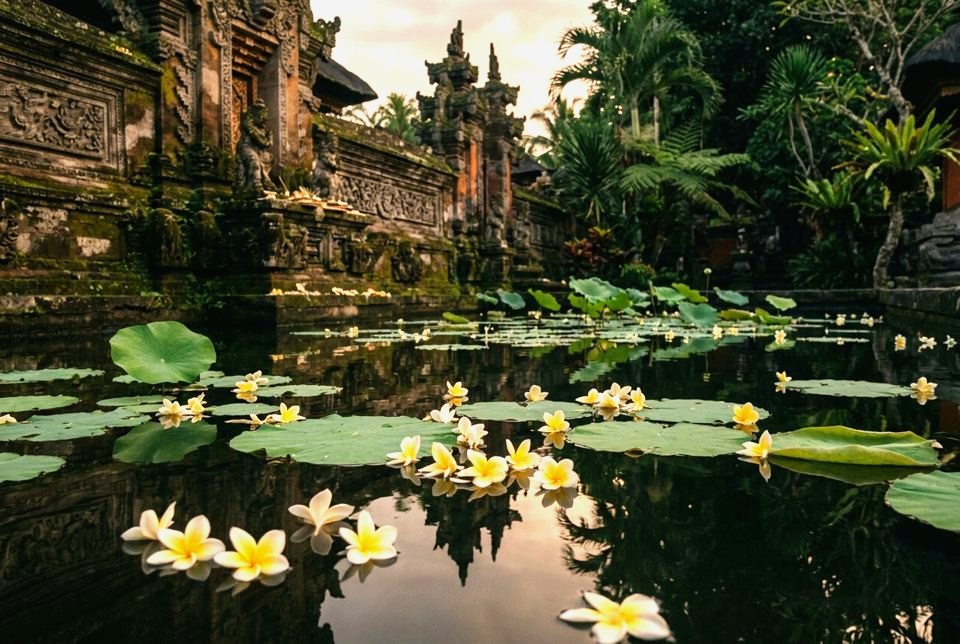
Qigong is a family of Chinese practices in which you cultivate vitality yourself through gentle movement, posture, breathing and focused attention. Jnana Kanda is a Balinese energy practice, passed on through direct transmission (shaktipat) from a living Grandmaster, in which the practitioner acts as a channel rather than a source. They have different purposes and are not interchangeable, but they can sit side by side in one person's life.
Qigong and Jnana Kanda both work with what traditions call vital energy, but they go about it differently. Qigong is a self-cultivated discipline: you learn movements, postures, breathing and attention, then practice them yourself, often every day. Jnana Kanda is a Balinese practice based on direct transmission, called shaktipat, from a living Grandmaster. The practitioner becomes a channel for a pure, intelligent energy and does not generate it personally. Because their purposes differ, neither replaces the other, and many people find room for both.
This article describes each practice according to its own tradition, compares them fairly, and explains where I (Mathieu SUN) think the real distinction lies. Both are complementary approaches to wellbeing and personal development. Neither is a medical treatment, and nothing here is a claim of cure.
What is qigong?
Qigong (also written qi gong or chi kung) is a broad family of Chinese mind-body practices. The name is usually explained as combining *qi*, often translated as vital energy or life force, with *gong*, meaning skill, work or cultivation. So it can be read as the skillful cultivation of vital energy. In the Chinese worldview, qi is a fundamental concept running through philosophy, medicine, martial arts and daily life.
This is a traditional framework, not a measured quantity. Modern science has not confirmed qi as a measurable physical substance. Qigong can be practiced and valued without anyone needing to settle that question.
Where does qigong come from?
Qigong has Chinese roots. Its practices draw on several streams: Daoist and Buddhist contemplative traditions, martial arts training, and the framework of traditional Chinese medicine. The word *qigong* as a single umbrella term for these methods is relatively modern. The older exercises it covers, such as guided stretching, breath regulation and meditation, belong to a much longer history. Because of this diversity, there is no single qigong. Styles differ widely in emphasis, lineage and purpose.
What does a qigong practice involve?
Most qigong systems combine four elements, in different proportions:
- Movement: slow, flowing, repeated sequences, or simple gentle exercises. Some styles are nearly still.
- Posture: attention to alignment, rooting, relaxation of the shoulders, softness in the joints. Standing postures are common.
- Breathing: deep, slow, often coordinated with the movement.
- Attention: a calm, focused awareness, sometimes directed through the body with imagery or intention.
Practitioners usually learn from a teacher or a class and then practice regularly on their own. The sense of progress comes from repetition and refinement over time. This is why qigong is often described as a self-cultivation discipline: the practice is yours, and you do it.
How are qigong and tai chi related?
Tai chi (taijiquan) is a Chinese martial art that is also widely practiced as a flowing, meditative movement form. It shares many principles with qigong: relaxed posture, coordinated breathing, calm attention and slow, continuous movement. Tai chi is often described as sitting close to qigong, and sometimes as a form of it, depending on who you ask. The usual distinction is that tai chi has a martial-arts structure and a longer set of linked forms, while qigong is a wider category that includes simpler, shorter exercises as well. Many teachers offer both.
Research on qigong and tai chi exists, especially around balance, relaxation and general wellbeing, but its quality and conclusions vary. Whether a particular practice suits you is best judged by your own experience and, for health conditions, by your healthcare professional.
What is Jnana Kanda?
Jnana Kanda is a traditional Balinese energy practice, carried today as a living lineage by Grandmaster Mahaguru Mangku Alit Ajna. I am a practitioner and teacher of Jnana Kanda, trained by him and receiving direct transmission from him. For a full introduction, see what Jnana Kanda is.
In the Grandmaster's teaching, human difficulties often involve three interconnected dimensions: the body, the energy (the vital force, comparable to what other traditions call prana or qi) and the mind (thoughts, emotions, beliefs, perception). Energy is seen as the bridge between body and mind, and imbalance often begins in the subtler layers before it shows up physically. Jnana Kanda approaches the three as one field, and it works alongside medical care rather than replacing it.
At its heart, the teaching describes a pure, intelligent, sacred energy that knows where to go and is not limited by distance, time or physical boundaries. The tradition says it is not created or controlled by the practitioner but received, allowed and transmitted. These are traditional teachings. They are not scientific claims.
What does transmission mean here?
The ability to work with this energy is awakened through shaktipat, a direct transmission through the Grandmaster. In the teaching, the practitioner then becomes a vessel or channel, a bridge between the seen and the unseen, and not the source. The source is described as the Pendopo Agung, a higher energetic centre of purity. Training with me includes the Balinese preparation of melukat, purification in living water, before transmission. You can read more in the article on initiation, melukat and shaktipat.
After transmission, the practice is sustained by three aligned forces. The mind directs through clear, still intention without doubt. The heart purifies through sincerity and compassion. The breath carries, deep, calm and conscious. It is a state of being more than a technique, and there is no fixed posture: one may sit, stand or lie down, and the body follows the energy.
Qigong vs. Jnana Kanda: how do they compare?
The table below summarizes the main differences. It describes tendencies, since qigong in particular is a broad family with many styles.
| Aspect | Qigong | Jnana Kanda |
|---|---|---|
| Cultural origin | Chinese traditions (Daoist, Buddhist, martial and medical streams) | Balinese tradition, carried as a living lineage by the Grandmaster |
| Core method | Movement, posture, breathing and attention practiced regularly | Receiving and allowing a pure energy through transmission; the practice is a state of being, not a technique |
| Who is the 'engine'? | You cultivate your own vitality through repetition | The practitioner is a channel, not the source; the person receiving is also invited to be open |
| Role of the teacher | Teaches forms and corrects practice; you then practice independently | Gives direct transmission (shaktipat); the Grandmaster's lineage is the origin of the ability |
| Posture and movement | Central: specific forms, stances and sequences | No fixed posture; the body follows the energy; movement may appear but is not required |
| Role of breath | Regulated and coordinated with movement | Deep, calm and conscious; one of three aligned forces with mind and heart |
| Concept of energy | Qi, within the Chinese framework | Sacred pure energy, in the Balinese teaching; comparable to prana or qi in other traditions |
| Consent and ethics | Varies by school; a personal discipline for most | The Law of Consent is central: energy must never be directed at someone without their awareness and permission |
| Time and commitment | Gradual, built through frequent practice | Transmission happens at a defined point; sustained by the practitioner's integrity and daily way of being |
| Typical purpose | Vitality, relaxation, mobility, balance, contemplative cultivation | Restoring natural coherence between body, energy and mind; serving others as a channel |
| Evidence | Some research exists on related practices; quality varies | Traditional teaching; no scientific confirmation of its energetic claims |
Self-practice versus transmission: the core difference
The most useful way to see the difference is by asking where the work happens.
In qigong, it happens in you, over time. You build familiarity with your own body, breath and attention. The benefits people describe, such as calm, better body awareness and a feeling of vitality, tend to come from consistent practice. If you stop practicing, the practice naturally fades. Some qigong schools also include a practice of directing qi to others, often called external qi, but this is an advanced element in certain lineages and is not what most people mean by qigong class.
In Jnana Kanda, the central act is receiving and transmitting. The Grandmaster's teaching holds that the energy is not made by the practitioner. The practitioner's task is to keep the channel clear: humility, sincerity, no harmful intention, respect for the natural order, and service without attachment. The tradition expresses this by saying that the purity of the energy depends on the purity of the vessel.
So one is a path of building a practice, and the other is a path of becoming a clear channel. They are different answers to different questions, and I would not call either a substitute for the other.
What distinguishes Jnana Kanda?
Without suggesting it is better than qigong or any other tradition, here is what I find distinctive about Jnana Kanda, in my own perspective as a practitioner and teacher:
- Balinese water culture. Bali is a water-based culture, and melukat, purification in living water, comes before transmission.
- Permission and humility. The Balinese approach to nature resembles entering someone's home: you ask, you do not impose. The Law of Consent applies this same respect to people.
- Gratitude. Daily offerings such as canang sari (flowers, water, incense and similar) express gratitude and respect toward nature. They are a cultural and personal expression, not something required in sessions.
- Direct transmission from a living Grandmaster. The aim is to preserve the purity of the teaching without ego.
- Simplicity. There is no fixed posture and no elaborate procedure. The teaching points to awareness, alignment and flow, with nothing to force, chase or control.
- Character of the practitioner. Humility, discipline, consistency, dedication, gratitude and service matter as much as skill.
Jnana Kanda does not try to add something artificial or force a result. It addresses what interferes with a person's natural coherence so that their own energy can flow more naturally. Nobody is seen as fundamentally defective or needing to become someone else.
The image I use is this: it is not about forcing the sun to shine, it is about allowing the flower to open. The practitioner does not impose an outcome. The person's openness, readiness and willingness to receive matter, and the intention is the highest good of all.
Can you practice qigong and receive Jnana Kanda?
Yes. They answer different needs, and nothing in the teaching of Jnana Kanda conflicts with a movement practice. Someone might use qigong or tai chi as a daily rhythm of gentle movement and breath, and turn to Jnana Kanda for a different kind of support, in a session or through the path of training. The Grandmaster's own list of practical balance includes sleep, nutrition, movement, breathing, time in nature, stillness and awareness of thoughts. Qigong fits naturally within that list.
Other approaches sit in the same wider landscape. If you are exploring several, these articles compare them: meditation and breathwork versus Jnana Kanda, acupuncture versus energy healing and Jnana Kanda and acupressure versus energy healing and Jnana Kanda. For a Reiki comparison, see energy healing vs Reiki. For a broader question, there is also What is the best energy-healing modality?, and the honest answer is that it depends on the person.
Who might find Jnana Kanda relevant — and who might prefer qigong?
No approach is automatically best for everyone. The person matters as much as the modality, and experiences vary.
Jnana Kanda may be relevant if you:
- Are drawn to a practice based on receiving and transmitting rather than on physical technique.
- Find it hard to sustain daily movement or meditation routines, or want something simple that does not rely on posture or form. (My article on why meditation doesn't work for some people explores this.)
- Value the Balinese cultural context: water, offerings, gratitude, humility.
- Are interested in becoming a practitioner through direct transmission, in the two-day in-person training.
- Want to experience a session, either online or in person in Cap d'Antibes, before deciding anything else.
Qigong may suit you better if you:
- Enjoy gentle movement and want a practice you do yourself, regularly, with a clear structure.
- Want to build body awareness, balance, flexibility and calm through physical practice.
- Prefer a path rooted in Chinese philosophy and movement forms, in a group class setting.
- Like the idea of progress through steady repetition under a teacher's guidance.
If your reason for looking is a medical concern, please speak with a qualified healthcare professional first. Both qigong and Jnana Kanda are complementary approaches. For questions of safety in Jnana Kanda, see is Jnana Kanda safe?
Frequently asked questions
Is qigong the same as energy healing?
Not exactly. Qigong is mostly a self-practice of movement, breath and attention for cultivating your own vitality, although some schools include working with another person's qi. Energy healing is a broader term for practices in which a practitioner works with energy for someone else. Jnana Kanda belongs to this second category, but it has its own transmission-based foundation and ethics.
Is Jnana Kanda a form of qigong or prana work?
No. Jnana Kanda is a distinct Balinese practice and is not a style of qigong. The Grandmaster's teaching notes that qi and prana are what other traditions call the vital force, but Jnana Kanda understands the energy it works with as a pure, intelligent, sacred energy that is received and transmitted rather than cultivated through exercise.
Do I need to learn qigong before Jnana Kanda, or the reverse?
No. They are independent paths and neither is a prerequisite for the other. If you already practice qigong, tai chi or meditation, you are welcome to explore Jnana Kanda, and many people simply keep both in their lives.
What does Jnana Kanda ask of the person receiving a session?
Openness, willingness and conscious acceptance. According to the Law of Consent, energy must never violate another being's freedom, and working on someone without their awareness or permission is a disruption of natural law, not healing. Nothing is required in terms of belief, posture or ritual. You can read more about what happens in an online energy healing session.
Can qigong or Jnana Kanda replace medical care?
No. Both are complementary practices for wellbeing and personal development. The Grandmaster's teaching is clear that the physical body still follows biological laws and that the wise path combines medical support, healthy living and deep awareness. Any remarkable change cannot be controlled, forced or expected.
Discover Jnana Kanda with Mathieu SUN
If you are curious about the transmission-based side of energy work, you can book an online session with me and experience Jnana Kanda directly, from wherever you are. You can also read more about me and my path as a Jnana Kanda teacher. Jnana Kanda is a complementary practice and does not replace medical care. For any health concern, please consult a qualified healthcare professional.
Sources and further reading
- Qigong — Wikipedia — overview of qigong's definition, history and varieties of practice.
- Tai chi — Wikipedia — background on tai chi and its relationship with qigong.
- Qi — Wikipedia — the concept of qi in Chinese thought and its role in traditional frameworks.
- Prana — Wikipedia — the Indian concept of vital force, comparable to qi in other traditions.
- Shaktipat — Wikipedia — general background on the concept of transmission of spiritual energy.