Crystal Healing vs. Jnana Kanda: Understanding Energy Approaches
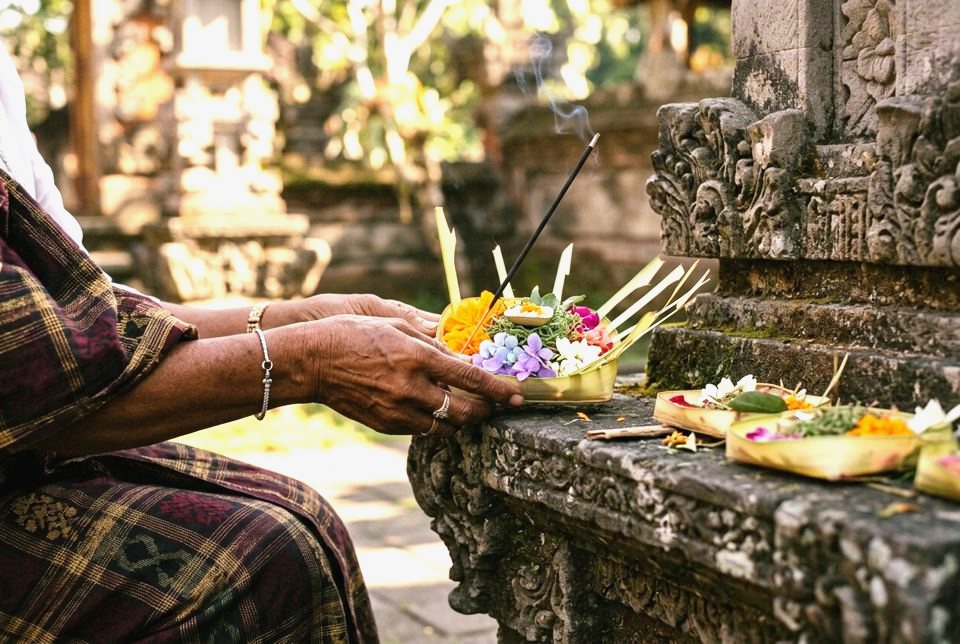
Crystal healing is a spiritual and complementary practice that uses stones, chosen for their symbolism, as tools for intention and relaxation. No scientific evidence shows that crystals have healing powers. Jnana Kanda is a Balinese energy practice that does not use crystals or any object: according to its tradition, a practitioner who has received Shaktipat acts as a channel, within a framework of consent, purification, gratitude and lineage. Neither replaces medical care.
Crystal healing and Jnana Kanda are often grouped together because both are described as working with energy, but they are very different in method. Crystal healing uses stones, chosen for their colour, form and symbolic meaning, as supports for intention and relaxation. Jnana Kanda, a traditional Balinese energy practice, does not use crystals or any other object. Its tradition describes a practitioner who acts as a channel for a pure, intelligent energy, within a framework of consent, purification, gratitude and direct transmission from a living Grandmaster. One point should be stated plainly from the start: no scientific evidence shows that crystals have healing powers. Both approaches are complementary practices for wellbeing and personal development, and neither replaces medical care.
This article describes crystal healing fairly, according to how its own practitioners understand it, and explains where Jnana Kanda differs. It is not an attempt to rank them. If you are weighing several approaches at once, What is the best energy-healing modality? offers a broader way to think about the choice.
What is crystal healing?
Crystal healing is a spiritual and alternative practice in which stones and minerals, such as quartz, amethyst or rose quartz, are used with the intention of supporting emotional, mental or physical wellbeing. Practitioners generally believe that each stone carries a particular “energy” or “vibration” that can interact with a person's own energy field. The practice has no single founder, central institution or unified doctrine, and the meanings given to individual stones vary widely between books, teachers and cultures.
People have valued stones for symbolic and protective purposes in many cultures and eras: as amulets, ornaments and ritual objects. The modern form of crystal healing, however, is largely associated with the New Age movement of the late twentieth century, which combined older symbolism with ideas about chakras, auras and subtle energy. It is best understood as a contemporary spiritual practice drawing on many sources, not as a single ancient system.
How is crystal healing usually practised?
Methods differ from one practitioner to another, but common elements include:
- Placing stones on or around the body while the person rests, often along the line of the chakras.
- Carrying or wearing a stone, such as a pendant or a pocket stone, as a reminder of an intention.
- Arranging stones in a “grid” in a room or around a person.
- Choosing stones by colour or type for a theme: calm, courage, love, clarity.
- “Cleansing” or “charging” stones with moonlight, sunlight, smoke, salt or sound.
For many people the appeal is simple and sensory. A stone is tangible, beautiful and easy to hold. It gives the mind something to rest on, and it can turn an intention into a small ritual. Those are real human experiences, and they deserve respect even though they do not prove that the stone itself is doing something.
Does crystal healing work? What does the evidence say?
There is no scientific evidence that crystals have healing powers. Crystal healing is generally classed as a pseudoscience, because its central claim, that stones emit or channel a healing energy that affects health, has not been supported by research. In controlled experiments that compared real crystals with imitation ones, participants reported similar sensations in both conditions. This pattern is usually attributed to expectation, suggestion and the placebo effect. You can read more in the Wikipedia overview of crystal healing and the article on the placebo.
That does not mean that people who use crystals are foolish or that the feelings they report are not real. Relaxation, ritual, attention and a sense of care can all influence how a person feels. It does mean that crystals should not be presented as a treatment, and that anyone with a medical concern should consult a qualified healthcare professional.
What is Jnana Kanda, and does it use crystals?
Jnana Kanda is a traditional Balinese energy practice. It is carried today as a living lineage by Grandmaster Mahaguru Mangku Alit Ajna, who transmits it directly through Shaktipat. Mathieu SUN practises and teaches it after training with and receiving transmission from the Grandmaster. For a full introduction, see What is Jnana Kanda?.
Jnana Kanda does not work by using crystals, stones, tools or devices. In the tradition's teaching, there is no required posture or instrument: a practitioner may sit, stand or lie down, and the body follows the energy. What the tradition emphasises instead is a state of being. The mind directs through a clear and still intention, the heart purifies through sincerity and compassion, and the breath carries, deep and calm. Together these form one unified field, which the teaching presents as more a way of being than a technique.
According to the tradition, the energy at the heart of Jnana Kanda is pure and intelligent, “knows where to go”, and is not limited by distance, time or physical boundaries. The practitioner does not create or control it. It is received, allowed and transmitted. These are traditional teachings and Mathieu SUN's perspective as a practitioner. They are not scientific claims and have not been scientifically confirmed.
Crystal healing vs. Jnana Kanda: how do they compare?
The table below summarises the main differences. It describes each approach according to its own stated principles, not according to any measured effect.
| Aspect | Crystal healing | Jnana Kanda |
|---|---|---|
| Origin | Modern spiritual practice, shaped largely by the New Age movement and drawing on older symbolic uses of stones | Traditional Balinese practice, carried as a living lineage by the Grandmaster |
| Central element | Stones and minerals chosen for colour, type and symbolic meaning | No physical tool; the practitioner as a channel, with mind, heart and breath aligned |
| How it is understood | Stones are believed to hold or channel a particular energy or vibration | A pure, intelligent energy that is received and transmitted, not created by the practitioner (traditional teaching) |
| Training and transmission | No standard training or lineage; varies by teacher and book | Shaktipat: direct transmission from the Grandmaster, followed by guided training |
| Relationship with nature | Stones come from the earth; “cleansing” rituals vary | Water purification (melukat), daily offerings (canang sari), and asking permission and showing humility toward nature |
| Role of consent | Practices differ; no common principle | The Law of Consent is central: working on someone without their awareness or permission is not healing |
| Scientific status | No evidence that crystals have healing powers; effects attributed to expectation and ritual | Not scientifically proven; presented as a traditional, complementary practice |
| Relation to medical care | Should not replace it | Works alongside medical care and does not replace it |
Seen side by side, the two approaches come from different places. Crystal healing begins with an object and its meaning. Jnana Kanda begins with the person, the practitioner's inner state and a lineage. If you are curious about how another popular approach compares, see Energy healing vs. Reiki.
What distinguishes Jnana Kanda?
Several foundations set Jnana Kanda apart. None of them is a claim of superiority, since the person matters as much as the modality, and different people feel at home in different approaches.
Balinese water culture and purification
Bali is a water-based culture. In the Balinese tradition, melukat is a purification in living water, and in the path of Jnana Kanda it comes before transmission. The idea is to arrive clear and open instead of loaded with noise. To explore this foundation in depth, read water purification in Balinese Jnana Kanda, or see how it fits with the initiation in melukat and Shaktipat.
Asking permission, and gratitude through offerings
In the Balinese approach to nature, one asks permission instead of imposing, much as you would when entering someone's home. Daily canang sari offerings, small baskets with flowers, water, incense and other elements, express gratitude and respect toward nature. They are a cultural and spiritual expression of that relationship. They are not something a person must do in a session.
Here the contrast with crystal healing is clearest. A crystal is something you take from the earth and apply. The Balinese offering is something you give back. Mathieu SUN sees this difference of attitude, receiving and thanking instead of using, as one of the most important in practice.
Direct transmission and a living lineage
The ability to practise Jnana Kanda is awakened through Shaktipat, a direct transmission from a higher source through the Grandmaster. The tradition names this source as the Pendopo Agung, described as a higher energetic centre of purity. The practitioner becomes a vessel, a bridge between the seen and the unseen, and not the source. The teaching also stresses preserving its purity without ego. This is a living transmission from a teacher who is still present today. Information about Shaktipat in general is useful background, although Jnana Kanda's own teaching is the reference for this lineage.
Ethics and the character of the practitioner
The tradition teaches that the purity of the energy depends on the purity of the vessel. Humility, sincerity, discipline, service without attachment and respect for the natural order of life are part of the path, as is the Law of Consent: energy is sacred, and acting on someone without their permission is a disruption of natural law, not healing. If you want to know more about how this shapes a session, Is Jnana Kanda safe? addresses it directly.
A practice that does not force
Mathieu SUN often describes the spirit of the work with one image: “It is not about forcing the sun to shine. It is about allowing the flower to open.” The practitioner does not force a result. What matters is the person's openness, readiness and willingness to receive, and the intention is the highest good of all, without a predetermined outcome. A person is not seen as fundamentally defective and does not need to become somebody else. The aim is to address what interferes with their natural coherence so that their own energy can flow more naturally.
Is there room for both? A balanced view
Some people use stones as a quiet daily ritual, a souvenir of a trip or a focus for meditation, and they enjoy it without expecting a medical outcome. If that is how you use them, there is little reason to feel guilty or to give them up. The difficulty arises when stones are sold as treatments, or when someone delays proper medical care because they believe a crystal will solve a health problem.
Likewise, Jnana Kanda should not be approached as a guaranteed solution. The tradition itself says that any “miraculous” aspect cannot be controlled, forced or expected, and that the wise path combines medical support, healthy living and deeper awareness. Changes, when they occur, are described as possibly instant or progressive, subtle or visible, and experiences vary from person to person.
If you are exploring several approaches, you may also like the comparisons with chakra healing, which often goes hand in hand with crystals, and sound healing, which uses instruments such as singing bowls.
Who might find Jnana Kanda relevant — and who might prefer another approach?
Jnana Kanda may be relevant if you:
- Are drawn to a practice with a living lineage and direct transmission rather than objects.
- Value consent, humility, gratitude and a close relationship with nature.
- Prefer simplicity: no equipment, no required posture, no belief system to adopt in advance.
- Want a complementary practice for wellbeing and personal development that sits alongside medical care.
- Are open and willing, without expecting a specific result.
Another approach may suit you better if you:
- Enjoy visual ritual, and working with stones is what helps you relax or concentrate.
- Want a framework that is built around objects, colours and symbolism.
- Are looking for evidence-based treatment of a medical or psychological condition. In that case, a physician or licensed therapist is the right first step.
- Prefer a purely secular practice such as breathing exercises, mindfulness or exercise.
There is no universal “best” choice. The most useful question is often not which modality is the strongest but which one you can approach honestly, safely and with realistic expectations.
Frequently asked questions
Do crystals have healing powers?
No scientific evidence shows that crystals have healing powers. Controlled experiments comparing real and fake crystals have found similar reported effects, which is generally explained by expectation and suggestion. Crystals can still carry personal, aesthetic or symbolic value, but they should not be used instead of medical care.
Does Jnana Kanda use crystals or stones?
No. Jnana Kanda does not work by using crystals, stones or any other tool. According to the tradition, the practice rests on the practitioner's state of being, with mind, heart and breath aligned, and on the transmission received through Shaktipat.
Is Jnana Kanda scientifically proven?
No. Jnana Kanda is a traditional practice, and its teachings about energy are presented as the tradition's perspective, not as established science. It is offered as a complementary practice for wellbeing and personal development, and it does not diagnose or treat medical conditions.
Do I need to bring offerings or do a purification to have a session?
No. Melukat and canang sari are part of the Balinese cultural and spiritual foundation of Jnana Kanda, and the tradition places purification before transmission. They are not required for you to book or attend a session. They are described here to explain the values of gratitude, respect and humility behind the practice.
Can I combine crystal practice and Jnana Kanda?
You are free to keep any personal ritual that feels meaningful to you, including a stone you like to hold. Jnana Kanda does not depend on one. If you have questions about how a session works, you can read what happens in an online energy healing session or ask Mathieu SUN before booking.
Can I replace medical treatment with energy practices?
No. Neither crystal healing nor Jnana Kanda replaces medical care. If you have a physical or mental health concern, see a qualified healthcare professional. Complementary practices can be considered alongside that care, not instead of it.
Discover Jnana Kanda with Mathieu SUN
If the Balinese approach appeals to you, whether through individual sessions online, in Cap d'Antibes or through the two-day in-person training, you can begin by choosing a format that suits you and book an online session with Mathieu SUN. Jnana Kanda is a complementary practice and does not replace medical care or professional treatment of any health condition.
Sources and further reading
- Crystal healing — Wikipedia — overview of the practice, its origins and its scientific status.
- Placebo — Wikipedia — background on expectation and the placebo effect, often used to explain reported effects of crystals.
- Balinese Hinduism — Wikipedia — context on the religious and cultural setting of Bali, including offerings and water rituals.
- Shaktipat — Wikipedia — general background on the concept of spiritual transmission.
- Complementary, Alternative, or Integrative Health: What's In a Name? — NCCIH — definitions of complementary and integrative approaches.