Water Purification and Energy Healing in Balinese Jnana Kanda
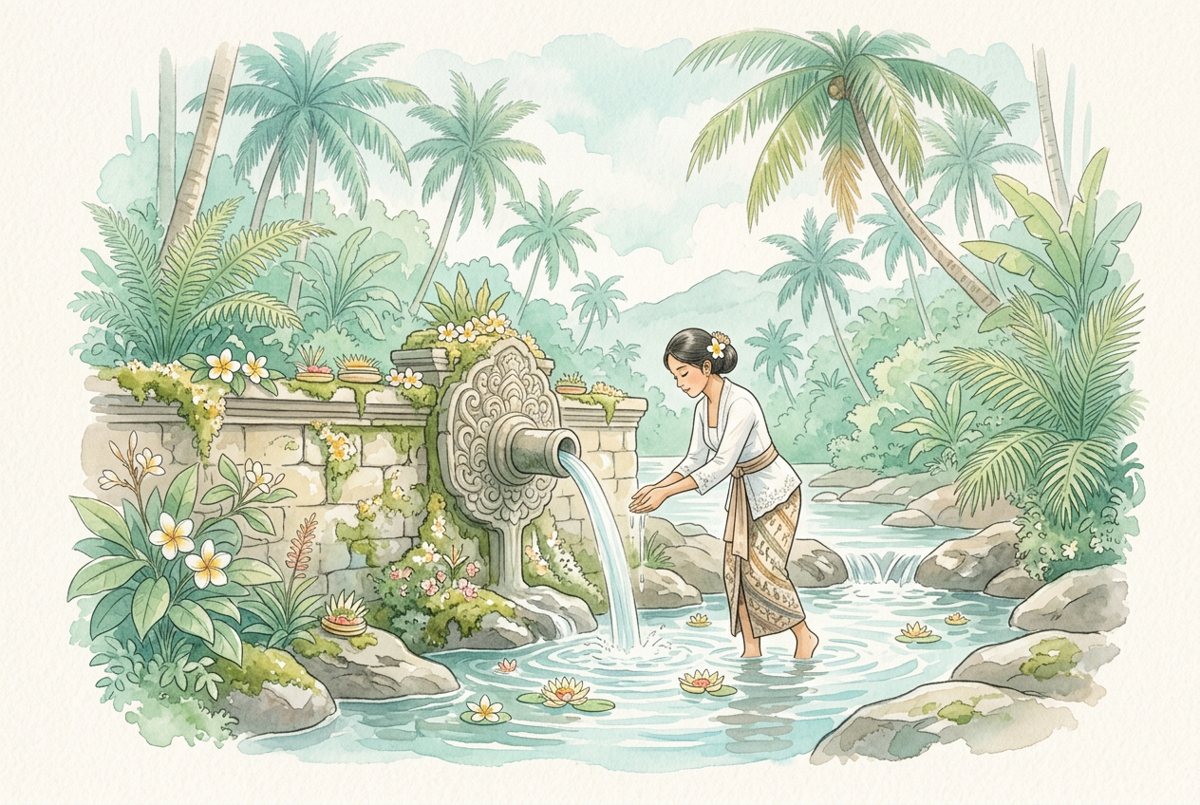
In Balinese culture, water purification (melukat) is a traditional way of cleansing and renewing oneself in holy or spring water. In the Jnana Kanda tradition, it is understood as preparation rather than treatment: a gesture of respect, humility and clarity that supports receptivity before energy work. It is a cultural and spiritual practice, not a medical one, and its meaning is traditional rather than scientifically demonstrated.
Water purification in Bali, known as melukat, is a traditional practice of cleansing and renewal in holy or spring water. In the Jnana Kanda tradition, it is understood as a form of preparation: a way of approaching energy work with respect, humility, clarity and openness. It is not a treatment, and it does not replace medical care. It is a cultural and spiritual gesture that sets the tone for everything that follows.
This article is the foundation of a series on Balinese energy healing. It explains why water holds such an important place in Balinese life, what melukat is, and how purification, asking permission, gratitude and offerings fit into the philosophy of Jnana Kanda as taught by Grandmaster Mahaguru Mangku Alit Ajna and shared by Mathieu SUN. We will also introduce the three dimensions that the tradition works with: body, energy and mind.
A note on how to read what follows. Some statements here are established facts about Balinese culture. Others are traditional beliefs, which are meaningful within the tradition but not scientific claims. And some are Mathieu SUN's perspective as a practitioner and teacher. We will try to make clear which is which.
Why does water matter so much in Balinese life?
Bali is often described as a water-based culture, and this is visible well beyond ritual. Balinese Hinduism is sometimes referred to as Agama Tirta, roughly the “religion of holy water”, because blessed water (tirta) appears in so many ceremonies, from temple festivals to family rites. Water is sprinkled, drunk in small amounts, and used to bless people, objects and spaces.
Water is also practical and communal. The traditional *subak* irrigation system, which organises how rice-terrace water is shared among farmers, is a well-documented example of water management that is tied to temples and religious life. UNESCO has recognised the subak landscape as part of a World Heritage site. For many Balinese, then, water is not only a resource. It is something to be shared fairly, respected and thanked.
Springs hold a particular place. Water temples are built around natural sources, and a spring is treated as a place where something precious emerges from the earth. This is the cultural setting in which melukat takes place.
What is melukat, the Balinese purification in water?
Melukat is a Balinese purification ritual in which a person is cleansed with holy water, often at a spring, a water temple or another sacred water source. People may do it for many reasons: to mark a new chapter, to let go of heaviness, to prepare for a ceremony, or simply to express gratitude and start afresh. In Balinese tradition, the focus is on cleansing in a spiritual and symbolic sense, not on treating a medical condition.
At well-known sites such as the Tirta Empul water temple near Tampaksiring, visitors may see people moving along a series of water spouts, praying and offering as they go. For Balinese practitioners this is a living act of faith, not a spectacle. If you ever take part as a visitor, the respectful approach is to follow local guidance, dress appropriately, ask when you are unsure, and treat the place as a place of worship.
It is worth being clear about what melukat is not. It is not a universal recipe for healing, and it is not necessary to be Balinese or to believe in any particular system to appreciate its meaning. What it offers, in the tradition’s own terms, is a way of stopping, being humble, and renewing intention.
Water, life and the body: philosophy rather than proof
There is a simple, established fact that often inspires reflection on water. Water makes up a large share of the adult human body, commonly cited as somewhere around half to two-thirds of body weight depending on age, sex and body composition. Life as we know it depends on water, and so does agriculture, which is why water holds such a central place in so many cultures.
From there, many traditions, including Balinese ones, build a philosophy: if we are largely water, and if life moves through water, then water is a natural symbol of cleansing, flow and renewal. This is a way of seeing, a symbolic and spiritual interpretation. It is not scientific evidence that water holds or transmits energy, that purification in water changes the body, or that a ritual produces measurable effects. Mathieu SUN presents it as a philosophy that gives melukat its meaning, and not as proof.
What can reasonably be said from experience is that many people find time in or near flowing water calming. Whether you explain this through tradition, psychology or simple physiology, the pause itself has value, and it is a good starting point for the kind of receptivity that energy work asks for.
Why does purification come before transmission in Jnana Kanda?
In the Jnana Kanda training that Mathieu SUN teaches, melukat comes before the transmission of the practice. The reasoning follows from the teaching itself. Jnana Kanda is described as a path of purity, humility and responsibility, and the teaching holds that the purity of the energy depends on the purity of the vessel. The practitioner is not the source of the energy, but a channel through which it is received and transmitted. Preparation of the vessel therefore matters.
Here “purification” is not about being flawed or unclean. A person is not fundamentally defective and does not need to become somebody else. Purification is closer to setting down noise: clearing a little room from fear, mental chatter and emotional resistance so that sincerity and openness can come forward. The tradition names these (ego, fear, doubt) as what distorts, blocks or weakens the practice, and a water ritual is one concrete way to mark the intention to put them down.
If you are curious about how this fits with the moment of transmission, called Shaktipat, you can read more in the article on Jnana Kanda initiation, melukat and Shaktipat.
Asking permission, gratitude and offerings
Water purification is one part of a wider attitude that runs through Balinese daily life and through Jnana Kanda: approaching nature and the unseen with humility. A helpful analogy is entering someone’s home. You do not walk in and rearrange the furniture. You ask, you greet, you thank. In the same way, Balinese practice begins with asking permission before acting.
The daily canang sari offering expresses this attitude. These small palm-leaf baskets hold flowers, and often incense and other elements, and are placed each day to give thanks and to ask permission of nature. They are an expression of gratitude and respect, not a transaction. Within Jnana Kanda sessions with Mathieu SUN, offerings are never presented as a requirement. They are part of the cultural background that shapes the spirit of the practice.
The same principle appears in what the tradition calls the Law of Consent. The teaching holds that energy is sacred and must never violate another being’s freedom. Working on someone without their awareness or permission is regarded as a disruption of natural law, not as healing. Openness, willingness and conscious acceptance are required. Consent and purification are therefore related ideas: both are about respect before action.
Gratitude is the third thread. According to practitioners, gratitude tends to arise naturally along the path, and Jnana Kanda is regarded by them as a sacred gift. Water, offerings and thanks are three ways of saying the same thing: I am not here to take, force or control.
Body, energy and mind: the three dimensions
To understand what purification is preparing for, it helps to know how Jnana Kanda sees a person. The tradition holds that many human difficulties trace back to three interconnected dimensions:
- The body: the physical and medical dimension.
- Energy: the vital force, which is non-medical and is what other traditions call prana or qi.
- The mind: thoughts, emotions, beliefs, perception and identity.
These form a triangle, and each influences the others. The mind affects energy, and energy affects the body. The body affects energy, and energy affects the mind. In this teaching, energy is the bridge layer between body and mind, and imbalance often begins in subtler layers before it becomes visible in the body. A helpful image is that the body is the vehicle, energy is the fuel and the mind is the driver.
The tradition also holds that the cycle can run in the other direction. When the mind calms, energy can rebalance, the body can follow, and a better state in turn supports the mind. This is the tradition’s perspective and not a scientific model, and it does not set aside the ordinary foundations of wellbeing: sleep, nutrition, movement, breathing, time in nature, stillness, emotional processing and a sense of meaning. If you want a broader introduction, see what Jnana Kanda is.
What distinguishes Jnana Kanda?
Many traditions use ritual cleansing, intention and some form of energy work, so it is worth saying plainly what is distinctive about Jnana Kanda, without suggesting it is better than anything else.
- Balinese water culture and melukat as groundwork. Purification is not an optional decoration. In the training, it comes before transmission.
- Permission and humility. Consent is central, and nature is approached the way one would enter someone’s home.
- Gratitude and daily offerings. Canang sari express respect and thanks. They are never prescribed as mandatory in sessions.
- Direct transmission from a living Grandmaster. The ability is awakened through Shaktipat from Grandmaster Mahaguru Mangku Alit Ajna. Jnana Kanda is described as a living Balinese lineage carried today by him, and the aim is to preserve the purity of the teaching without ego.
- Simplicity. There is no fixed posture. One may sit, stand or lie down, and the body follows the energy.
- The character of the practitioner. Humility, discipline, consistency, service and respect are treated as part of the practice, not as extras.
The tradition teaches that the energy is intelligent, not limited by distance, time or physical boundaries, and that it restores harmony without force. It is received, allowed and transmitted, not created or controlled by the practitioner. These are traditional teachings, and not scientific claims.
The guiding image is this: It is not about forcing the sun to shine. It is about allowing the flower to open. The practitioner does not force a result. What matters is the person’s openness, readiness and willingness to receive, with the intention of the highest good of all and no predetermined outcome imposed.
Melukat and Jnana Kanda: how do they relate?
Because the two are often mentioned together, it helps to separate them. Melukat is a Balinese cultural and religious ritual with its own meaning for the Balinese. Jnana Kanda is an energy practice that includes melukat as preparation in its training. They are connected, but they are not the same thing.
| Aspect | Melukat (Balinese water purification) | Jnana Kanda |
|---|---|---|
| What it is | A traditional purification ritual in holy or spring water, rooted in Balinese religious life | A Balinese energy practice working with the relationship between body, energy and mind |
| Main purpose | Spiritual cleansing, renewal and gratitude, according to Balinese tradition | Supporting a person’s natural coherence so their own energy can flow more naturally, as a complementary practice |
| Role of the practitioner | Often guided by local custom and by temple or ritual officiants | A vessel or channel; the energy is received and transmitted, not generated |
| Relationship to the other | Can be undertaken on its own, for its own reasons | In Mathieu SUN’s training, melukat comes before transmission |
| Medical status | Not a medical treatment | Not a medical treatment; it works alongside medical care |
Who might find Jnana Kanda relevant, and who might prefer another approach?
No single approach is automatically best for everyone. The person matters as much as the modality, and experiences vary from one individual to another.
Jnana Kanda may resonate with you if you are drawn to a simple, quiet practice, if you value ethics and humility in a practitioner, if the idea of asking permission and showing gratitude feels natural, or if you want a complementary approach that works with body, energy and mind together. It can be received in person or remotely, as the tradition teaches that the energy is not limited by distance. You can read more in the article on distance energy healing and online Jnana Kanda sessions.
You might prefer another approach if you want a practice with extensive written scientific literature, if you are looking for a highly structured, standardised protocol, or if a particular tradition already speaks to you more deeply. That is a perfectly good reason to choose differently. If you have a medical concern, please see a qualified healthcare professional first. Jnana Kanda works alongside medical care, not in place of it.
If you are weighing different paths, these articles may help: What is the best energy-healing modality?, Jnana Kanda and Reiki: the differences, and shamanic healing and Jnana Kanda compared. If you are new to the question of safety, is Jnana Kanda safe? is a good place to start.
Frequently asked questions
Do I need to do melukat to receive a Jnana Kanda session?
No. Melukat is part of the in-person training and transmission, where it comes before Shaktipat. It is not a requirement for an individual session. Offerings and rituals are never presented as mandatory in sessions with Mathieu SUN.
Is water purification a medical or healing treatment?
No. In Balinese tradition, melukat is a spiritual and cultural purification practice. It is not a medical treatment and should not be used in place of professional healthcare. Its meaning is traditional, and it should not be understood as a scientific or clinical claim.
Does the water in your body make energy healing work?
There is no scientific evidence for that claim, and Jnana Kanda does not rely on it. The fact that the human body contains a lot of water is established, but linking this to energy is a philosophical interpretation within certain traditions. It is a way of reflecting on life and flow, not a proof.
Can I visit a Balinese water temple respectfully as a tourist?
Many temples welcome visitors, but they are active places of worship. Dress modestly, follow local guidance and posted rules, ask before taking part in a ritual, and remember that some practices are meant for devotees. If you are unsure, observe quietly or ask a local guide or temple official.
What is the role of canang sari in Jnana Kanda?
Canang sari are the small daily offerings of flowers, incense and other elements that Balinese people place to express gratitude and ask permission of nature. In Jnana Kanda they reflect the spirit of respect and thanks. They are part of the cultural context, and not something you must do in order to benefit from a session.
Can Jnana Kanda be done online without any water ritual?
Yes. Online sessions with Mathieu SUN are offered without any water ritual. According to the tradition, the energy is not limited by distance. As with any complementary practice, experiences vary, and results are never guaranteed. See the online sessions overview or what happens in an online energy healing session.
Discover Jnana Kanda with Mathieu SUN
If this approach speaks to you, you can book an online session with Mathieu SUN, or learn more about sessions in Cap d’Antibes and the two-day in-person training. You can also read about Mathieu SUN and his path as a Jnana Kanda teacher. Jnana Kanda is a complementary practice for wellbeing and personal development. It does not replace medical care, and anyone with a health concern should consult a qualified healthcare professional.
Sources and further reading
- Balinese Hinduism (Wikipedia) — background on Balinese religious life, including the central role of holy water.
- Subak (Bali) (Wikipedia) — the traditional Balinese water-management system linked to temples and community life.
- Holy water (Wikipedia) — how water is used as a symbol of blessing and purification across traditions.
- Body water (Wikipedia) — the established facts about water content in the human body.
- Prana (Wikipedia) — the concept of vital force in Indian traditions, comparable to what Jnana Kanda calls energy.