Jnana Kanda vs Magnétiseur: Energy Healing Compared
Traditional magnétisme in France is a folk and historical practice in which a magnétiseur works with intention and presence to support someone's wellbeing, with methods that vary widely from one person to another. Jnana Kanda is a Balinese energy practice received through direct transmission (shaktipat) from a living Grandmaster, with its own framework of consent, humility and gratitude. Both are complementary practices, not medical treatments, and neither replaces a doctor.
If you are wondering how Jnana Kanda compares with a magnétiseur, here is the short version. Both belong to the broad family of complementary practices aimed at wellbeing, and both rest on the idea that a person can be supported through something other than a pill or a physical manipulation. They differ in origin, framework and way of working. French magnétisme is a popular tradition with historical roots in Europe and a great deal of individual variety. Jnana Kanda is a Balinese practice transmitted directly through a living Grandmaster, with a specific ethic built around consent, humility and gratitude. Neither is a medical treatment.
This article describes magnétisme fairly, according to how its own practitioners and history present it. It then explains what Jnana Kanda is, where the two overlap and differ, and how Mathieu SUN positions himself, since his name is often searched alongside the words “magnétiseur” and “Antibes”. For a broader view across several approaches, see What is the best energy-healing modality?
What is magnétisme, and what does a magnétiseur do?
In France, a magnétiseur is someone who offers what is often called a soin énergétique or soin par magnétisme. The practitioner typically works with the body’s subtle energy, together with focused intention and presence. The idea is to “transmit” or rebalance a form of vital energy, sometimes described as a fluid, to help the person feel better, calmer or more at ease. People commonly consult a magnétiseur for stress, tension, sleep difficulties, emotional heaviness or general fatigue, and sometimes for physical discomfort alongside medical care.
The word “magnétiseur” is not a regulated healthcare title in France. There is no single curriculum, exam or governing body behind it, so training, ethics and style differ considerably from one practitioner to the next. Some learned from a relative, some from a course, and some say they discovered their ability spontaneously. A practitioner of this kind is not a doctor and, under French law, should not diagnose illness or advise stopping medical treatment. Our existing guide, Qu'est-ce qu'un magnétiseur ?, covers the French context in more detail.
Where does magnétisme come from? Mesmer and animal magnetism
The term goes back to Franz Anton Mesmer (1734–1815), an Austrian-German physician who proposed in the 18th century a natural force he called “animal magnetism”, a kind of universal fluid he believed could be directed to restore health. His ideas spread widely in Paris in the 1780s. One of his followers, the Marquis de Puységur, developed a related approach that produced a sleep-like trance state, which later influenced the history of hypnosis.
This history also includes a critical chapter. In 1784, a French royal commission that included Benjamin Franklin and Antoine Lavoisier examined Mesmer's claims. It concluded that there was no evidence for a magnetic fluid and attributed the observed effects to imagination and suggestion. That is part of the documented record, and it explains why magnétisme has had a contested standing in the scientific world ever since.
Rebouteux, guérisseurs and popular healing traditions
Alongside this learned history, rural France has a long popular tradition of local healers: rebouteux (traditional bonesetters), guérisseurs, and practitioners sometimes called coupeurs de feu, who are asked to ease burns and similar discomforts, often through inherited words or gestures. Today the word magnétiseur often sits in the same cultural family. It is a figure of proximity: someone in your region, known by word of mouth, who offers help outside the medical system. Many people value precisely that human closeness.
What happens in a typical séance?
There is no standard format, which is the honest answer. A séance may last from fifteen minutes to an hour. The practitioner may ask a few questions, work with the person’s energy, or work in silence. Some work remotely or by phone. Some use objects such as a pendulum. Others add breathing, visualisation or prayer. This diversity is part of the tradition, and it means that two people who both call themselves magnétiseur may work in very different ways.
What does science say about magnétisme and energy work?
It is worth separating what is established from what is traditional belief. Established: the historical facts above, including Mesmer's theory and the 1784 commission's conclusion. Also established: there is no scientific confirmation of a measurable “magnetic fluid” or of a vital energy that can be detected and transferred from one person to another. People nonetheless report feeling calmer, more relaxed or more supported after energy sessions, and relaxation, attention, expectation and human presence are known to influence how people feel.
Traditional belief, on the other hand, holds that a vital energy exists and can be influenced. Many cultures describe it: prana in the Indian traditions, qi in Chinese thought, and the notion of vital force in older European vitalism. These are frameworks of understanding within their own traditions, not scientific findings. This applies equally to magnétisme and to Jnana Kanda, and an honest article should say so.
What is Jnana Kanda?
Jnana Kanda is a traditional Balinese energy practice, carried today by the Grandmaster Mahaguru Mangku Alit Ajna, a living lineage. Mathieu SUN trained with him and received direct transmission from him, known as shaktipat. In the teaching, human difficulties are understood through three interconnected dimensions: the body, energy and the mind. Energy is seen as the bridge between the other two. Imbalance often begins in the subtler layers before showing up in the body, and calming one dimension can help the others settle. The tradition describes the body as the vehicle, energy as the fuel and the mind as the driver.
Jnana Kanda does not aim to add something artificial or to force an outcome. Within the tradition, the body is understood to have its own inner intelligence, and the practice is seen as removing interference such as fear, mental noise and emotional resistance so that this natural coherence can function. Healing is understood as something remembered rather than given. For a fuller introduction, read What is Jnana Kanda?
“It is not about forcing the sun to shine. It is about allowing the flower to open.”
This image summarises the spirit of the practice. The practitioner does not push for a particular result. What matters is the person's openness, readiness and willingness to receive, and the intention is the highest good of all, without imposing a predetermined outcome.
Jnana Kanda vs magnétisme: a fair comparison
The table below describes each approach in general terms. Magnétisme in particular is a loose category, so the column on the left describes common features rather than every practitioner. Experiences and results vary in both cases.
| Aspect | Magnétisme / magnétiseur | Jnana Kanda |
|---|---|---|
| Origin | European and French folk tradition, with roots in Mesmer's 18th-century animal magnetism and in popular healers such as rebouteux | Traditional Balinese practice, carried today as a living lineage by Grandmaster Mahaguru Mangku Alit Ajna |
| How the ability is acquired | Varies: family transmission, courses, self-taught, or described as a natural gift | Awakened through shaktipat, a direct transmission from the Grandmaster, followed by training and practice |
| Role of the practitioner | Often seen as the person who emits, transmits or directs energy | Seen as a vessel or channel, a bridge, not the source; energy is received, allowed and transmitted rather than created or controlled |
| Concept of energy | Vital fluid or energy, often associated with the practitioner | Pure, intelligent sacred energy that, in the teaching, “knows where to go” and is not limited by distance or time |
| Method | Intention, sometimes pendulum, prayer or other tools; highly variable | No fixed posture; mind directs, heart purifies, breath carries; a state of being more than a technique |
| Consent | Practised in good faith by most, but no shared code across practitioners | A core principle: the Law of Consent. Working on someone without their awareness or permission is considered a disruption, not healing |
| Cultural elements | Regional customs, sometimes Christian prayer or inherited formulas | Balinese water culture and purification (melukat), daily offerings (canang sari) as gratitude and respect, asking permission |
| Regulation and framework | Title not regulated; no single standard of training or ethics | Ethical framework within the teaching (humility, responsibility, service); not a regulated healthcare profession |
| Relation to medicine | Should be complementary; practitioners must not diagnose or replace medical care | Complementary; does not replace medical care and works alongside it |
| Scientific status | No scientific confirmation of a magnetic fluid; contested since the 1784 commission | No scientific claims; presented as a traditional teaching and practice |
Seen side by side, the common ground is real: a human presence, a quiet setting, attention and the intention to help. The difference lies mostly in the framework behind the gesture, in how the practitioner understands their role, and in the ethics that are stated openly.
What distinguishes Jnana Kanda?
Without suggesting it is better than other approaches, several features give Jnana Kanda its particular character.
Jnana Kanda is entirely touchless. Mathieu SUN never touches the person, whether the session takes place in Cap d’Antibes or online. In the understanding of the tradition, this is more than a matter of comfort: the practitioner is a channel, not the source, and without physical contact there is no mixing of personal energy between practitioner and receiver. Nothing of the practitioner’s own fatigue or emotions is passed on, and the practitioner does not take on the person’s heaviness, so the energy stays clean, which the teaching links to the purity of the vessel. It also makes the session simple and comfortable for anyone who prefers not to be touched.
- A living, direct transmission. The ability is awakened through shaktipat from the Grandmaster himself, not learned only from books or courses. Mathieu SUN explains the process in Jnana Kanda initiation: melukat and shaktipat.
- Water and purification. In Balinese culture, water is central, and melukat, purification in living water, comes before transmission.
- Asking permission and approaching with humility. The tradition's analogy is entering someone's home: you ask, you do not impose. This applies to people and to nature alike, and it is why consent is a principle of the practice.
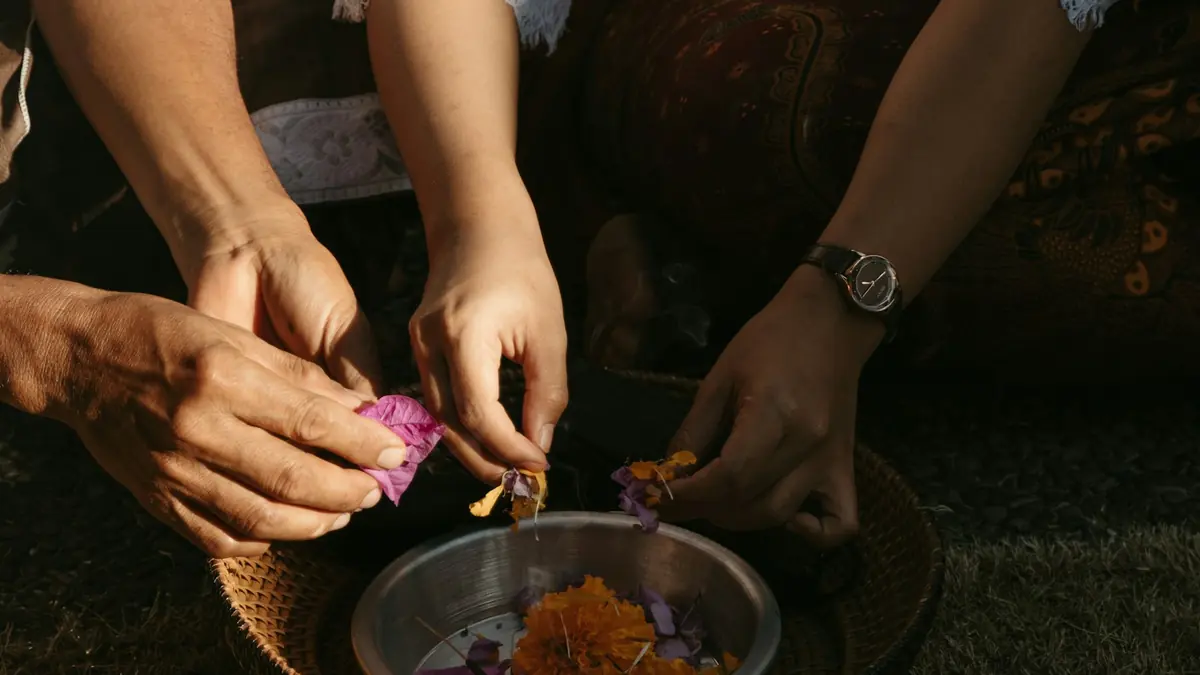
- Gratitude and offerings. Daily canang sari offerings of flowers, water, incense and similar items express gratitude and respect. They belong to the practitioner's way of life. They are not something clients are required to do in sessions.
- The practitioner as vessel, not source. The teaching states that the purity of the energy depends on the purity of the vessel. This puts character at the centre: humility, discipline, consistency, service and respect, with no claim to be greater than anyone else.
- Addressing disturbances, not forcing results. The approach looks at what interferes with a person's natural coherence so that their own energy can flow more naturally. A person is not seen as fundamentally defective and does not need to become somebody else.
- Simplicity. No fixed posture, no elaborate equipment. The body follows the energy.
If you want to know how these questions of safety and ethics play out in practice, Is Jnana Kanda safe? addresses them directly.
Is Mathieu SUN a magnétiseur? How he positions himself
Many people looking for a magnétiseur in Antibes or on the Côte d'Azur come across Mathieu SUN. The search is understandable, since in French the word magnétiseur has become a general label for someone who offers a soin énergétique. Mathieu SUN's own positioning is more precise. He is a practitioner and teacher of Jnana Kanda, a Balinese tradition. He does not present his work as French magnétisme, and he does not claim to be a doctor or a therapist.
In practice, this means a few things. Sessions are offered as a complementary practice for wellbeing and personal development. There is no diagnosis, no promise of a cure and no suggestion to stop medical treatment. Consent and openness come first, and the approach relies on what the person is ready to receive rather than on forcing an outcome. You can read more in Mathieu SUN, Jnana Kanda teacher.
Sessions take place in person in Cap d'Antibes or online. If you wonder how a distance session works, What happens in an online energy healing session? walks through it step by step. The tradition teaches that this energy is not limited by distance, which is a traditional teaching and not a scientific claim.
How does Jnana Kanda differ from other approaches you may be comparing?
If you are exploring several options, you may find these comparisons useful. Jnana Kanda vs Reiki: differences looks at another widely known Japanese-origin practice, and the older energy healing vs Reiki overview gives a broader context. Massage vs energy healing with Jnana Kanda clarifies the difference between a physical, hands-on treatment and an energy practice (see also soin énergétique ou massage ?). And shamanic healing vs Jnana Kanda compares two spiritually rooted traditions.
No single modality is automatically best for everyone. The person matters as much as the method: your sensitivity, your culture, what feels trustworthy to you and what you are looking for. Someone may feel at home with a local magnétiseur recommended by a neighbour. Another person may feel more drawn to a practice with a defined lineage and a clear ethical framework. Both are legitimate choices.
Who might find Jnana Kanda relevant, and who might prefer another approach?
Jnana Kanda may be relevant if you
- are curious about an energy practice with a defined lineage, direct transmission and a stated ethical framework;
- value consent, calm and non-intrusive work, with no pressure to believe anything;
- resonate with the idea that body, energy and mind are connected and that natural coherence can be supported rather than forced;
- are open to Balinese cultural elements such as gratitude, purification and respect for nature, without being required to adopt them;
- want sessions either in Cap d'Antibes or online, from home.
You might prefer another approach if you
- want a local, community-rooted practitioner with a long personal reputation in your own village or region, as is often the case with a traditional magnétiseur;
- prefer a physical, hands-on treatment such as massage, physiotherapy or osteopathy;
- are looking for a clinical or psychological framework, in which case a psychologist or psychotherapist is the appropriate professional;
- need diagnosis or treatment for a medical condition, which calls for a doctor first.
If you have a medical concern, see a qualified healthcare professional. Complementary practices can be a support alongside care, not a substitute for it.
How to choose any energy practitioner wisely
Whether you consult a magnétiseur, a Reiki practitioner or a Jnana Kanda practitioner, a few questions help. Does the practitioner explain clearly what they do and do not do? Do they avoid diagnosing, promising cures or discouraging medical care? Do they respect your consent and your pace? Is the price transparent? Do you feel respected, with no pressure and no dependency being created? Trust your sense of ease, and do not hesitate to ask questions before booking.
Frequently asked questions
Is Jnana Kanda touchless?
Yes. Jnana Kanda is entirely touchless, in person and online. In the tradition’s understanding, the absence of physical contact means there is no exchange or contamination of personal energy between practitioner and receiver: the practitioner acts as a clear channel, not as the source.
Is a magnétiseur the same as an energy healer?
Not exactly. In France, magnétiseur refers to a specific folk tradition linked to magnétisme, while energy healer is a broader term covering many approaches, including Reiki, qi-based practices and Jnana Kanda. In everyday speech the terms often overlap, and practitioners differ widely, so it helps to ask how someone actually works.
Is Jnana Kanda a form of magnétisme?
No. Jnana Kanda is a Balinese practice transmitted through a living lineage, with its own teaching on energy, consent and the practitioner as a vessel. It may seem close to magnétisme because both involve energy and intention, but their origins, frameworks and ethics differ.
Can a magnétiseur or Jnana Kanda practitioner cure an illness?
No. Neither is a medical treatment, and neither should be presented as a cure. These are complementary practices for wellbeing, relaxation and personal development. For any medical concern, consult a doctor, and consider an energy practice only as an addition to that care.
Does science support magnétisme or Jnana Kanda?
There is no scientific confirmation of a measurable energy or magnetic fluid in either case. The 1784 French commission on Mesmer's theory found no evidence for a magnetic fluid. Jnana Kanda is presented as a traditional teaching, not as a scientific claim, and personal experiences vary.
Do I need to believe in energy for a session to be worthwhile?
Belief is not required in Jnana Kanda, but openness and willingness matter, because the tradition says that consent and readiness are part of the process. You are free to come with curiosity and to judge by your own experience, without any expectation of a specific outcome.
Can I have a Jnana Kanda session if I live far from Antibes?
Yes. Mathieu SUN offers one-to-one online sessions as well as in-person sessions in Cap d'Antibes. According to the tradition, the energy is not limited by distance, which is a traditional teaching rather than a scientific statement.
Discover Jnana Kanda with Mathieu SUN
If the approach described here speaks to you, you can book an online session with Mathieu SUN and experience Jnana Kanda for yourself, with no obligation to adopt any belief. Sessions are a complementary practice for wellbeing and personal development. They do not replace medical care, and you should always consult a qualified healthcare professional for any medical concern.
Sources and further reading
- Franz Mesmer — Wikipedia — background on Mesmer, animal magnetism and the 1784 commission.
- Mesmerism — Wikipedia — history and reception of Mesmer's ideas and their link to hypnosis.
- Franz Anton Mesmer — Britannica — biographical overview of Mesmer and his theory.
- Vitalism — Wikipedia — the historical idea of a vital force, behind many energy concepts.
- Prana — Wikipedia — the concept of vital energy in Indian traditions.
- Qi — Wikipedia — the concept of vital energy in Chinese thought.