Shamanic Healing vs. Jnana Kanda: Comparing Traditional Practices
“Shamanic healing” is not a single method. It is a broad label for many practices across cultures, from Indigenous traditions to modern neo-shamanism, which often involve ritual, altered states and work with spirit helpers. Jnana Kanda is one specific living Balinese practice, received through direct transmission (shaktipat), in which the practitioner acts as a channel and does not journey, direct or control the process. Both are complementary practices for wellbeing and personal development, not medical treatments, and neither is automatically better for everyone.
Shamanic healing and Jnana Kanda are both described as traditional, spiritually rooted approaches to wellbeing, but they are not two versions of the same thing. “Shamanic healing” is an umbrella phrase covering very different practices in very different cultures, while Jnana Kanda is a single, specific Balinese practice carried today by one living Grandmaster. This article compares them fairly: their cultural context, the role of ritual and nature, how permission is understood, and what each asks of the practitioner. Both are complementary practices, not medical treatments.
A note on perspective. I am Mathieu SUN, a practitioner and teacher of Jnana Kanda. I am not a shaman and I do not speak for any shamanic tradition. Where I describe shamanic practices, I keep to broadly documented, general points and avoid claims about any one people or lineage. Where I describe Jnana Kanda, I stay faithful to what the Grandmaster teaches. Statements about energy are the tradition’s perspective and are not established science.
What do people mean by “shamanic healing”?
The word “shaman” entered Western languages from Siberia. It is generally traced to a word in the Tungusic (Evenki) language, reached Europe through Russian accounts, and was later applied by scholars and travellers to ritual specialists in many unrelated cultures. Since then it has become a catch-all term. Reference works such as Britannica and Wikipedia note that practices grouped under shamanism differ greatly in belief, technique and social role.
That diversity is the first thing to keep in mind. Treating “shamanism” as one method risks flattening cultures that have their own languages, cosmologies and rules. Many Indigenous communities also prefer their own terms for their healers and ritual specialists. It helps to separate at least three broad meanings.
Indigenous and culturally embedded traditions
In many societies, a healer or ritual specialist holds a recognised role within a community. Their work is usually inseparable from local cosmology, relationships with place, ancestors or spirits, and obligations to the people they serve. Training, authority and protocol typically come from within that culture. In these cases the practice is less a “technique” than part of a way of living, and it cannot be fully understood apart from its context.
Core shamanism and neo-shamanism
In the twentieth century, some Western practitioners and teachers adapted elements they saw as common across traditions into methods taught outside their original cultures. Core shamanism, associated with the anthropologist Michael Harner, is a well-known example. It commonly involves rhythmic drumming, guided journeying and work with spirit helpers. More broadly, neoshamanism describes a wide range of contemporary, often eclectic practices. Some people find these approaches meaningful. Others, including some Indigenous voices, raise concerns about cultural appropriation and about detaching practices from the communities that created them.
Everyday usage
Today “shamanic healing” on a website or in a studio can mean almost anything, from a drum journey to a ceremony with plant medicines to a rebranded energy session. This is why the question “is shamanic healing better or worse than X?” has no single answer. The honest question is: which practice, in which cultural frame, with which practitioner?
What is Jnana Kanda in its own context?
Jnana Kanda is a traditional Balinese energy practice. Its teaching is that most human difficulties involve three interconnected dimensions: the body, energy (the vital force that other traditions call prana or qi) and the mind, including thoughts, emotions, beliefs and identity. In this view, energy is the bridge between body and mind, and imbalance often begins in subtler layers before it shows up physically. You can read the full introduction in What is Jnana Kanda?.
At the centre of the practice, according to the teaching, is a pure and intelligent sacred energy that “knows where to go”, is not limited by distance or time, and restores harmony without force. The practitioner does not create or control it. The ability is awakened through Shaktipat, a direct transmission from a higher source through the Grandmaster Mahaguru Mangku Alit Ajna, and the practitioner becomes a vessel or channel, not the source. The teaching names that source as the Pendopo Agung, described as a higher energetic centre of purity. These are traditional teachings, not scientific claims.
Jnana Kanda is described as a living Balinese lineage carried today by the Grandmaster. It does not replace medical care and works alongside it. For the transmission process itself, including purification in water before initiation, see Jnana Kanda initiation: melukat and Shaktipat.
How do shamanic healing and Jnana Kanda compare?
The table below compares typical features. Because shamanic practices are so varied, the left column describes general tendencies, with exceptions in both directions. It is not a description of any specific tradition.
| Aspect | Shamanic practices (general) | Jnana Kanda |
|---|---|---|
| Origin and meaning of the term | A word of Siberian origin, applied later to many unrelated traditions worldwide | A specific Balinese practice with its own name, teaching and Grandmaster |
| Cultural frame | Ranges from deeply embedded Indigenous traditions to modern, adapted neo-shamanic methods | Rooted in Balinese culture, including water purification and daily offerings, transmitted today by a living Grandmaster |
| Transmission and training | Varies: community roles, apprenticeship, spirit calling, or workshop-based training | Awakened through Shaktipat, a direct transmission from the Grandmaster, in the tradition’s framework |
| Typical methods | Often ritual, drumming or rattling, journeying, altered states, work with spirit helpers (varies widely) | No fixed posture or elaborate technique; the practice is described as a state of being (mind directs, heart purifies, breath carries) |
| Role of the practitioner | Frequently an active intermediary who travels, negotiates or works with spirits, depending on tradition | A vessel or channel; the energy is received, allowed and transmitted, not directed or controlled |
| Nature | Often central: place, animals, plants, elements, ancestors (details depend on the culture) | Approached with humility and gratitude; water and the canang sari offering are part of the Balinese context |
| Permission and consent | Protocols differ by tradition and practitioner; many emphasise respect and permission | The Law of Consent is a core teaching: working on someone without their awareness or permission is not healing |
| Relationship to medicine | Varies; responsible practitioners present it as complementary | Complementary; it does not replace medical care |
| Evidence | Anthropological and personal accounts; scientific confirmation of spiritual claims is lacking | Traditional teaching and personal experience; no scientific proof is claimed |
Cultural context and lineage
The most important difference is specificity. A shamanic practice usually belongs to a particular people, landscape and worldview, or else it is a modern synthesis. Jnana Kanda belongs to one Balinese lineage and one teacher. For anyone choosing between them, the useful questions are the same for both: where does this practice come from, who taught the person offering it, and are they transparent about what they do and do not claim?
Ritual and the role of nature
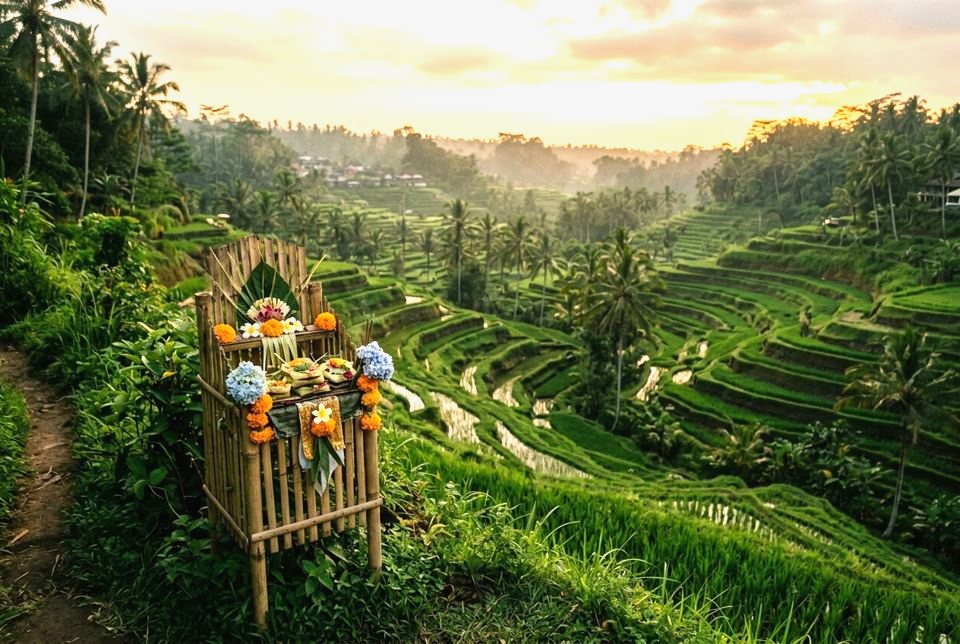
Many shamanic traditions work through elaborate ritual: sacred objects, sound, fire, dance, plants or specific places. Nature is often central, not as scenery but as a community of relationships. Jnana Kanda shares a deep respect for nature, but its expression is distinctly Balinese. Bali is a water-based culture, and melukat, purification in living water, comes before transmission. Daily canang sari offerings of flowers, water and incense express gratitude and ask permission. They are cultural expressions of respect and are never required in a session. The Balinese relationship with water is explored further in water purification, energy healing and Jnana Kanda.
In session itself, Jnana Kanda is simple. There is no fixed posture: a person may sit, stand or lie down, and the body follows the energy. Movement may be guided only to make the process visible. In stillness, the teaching says, the energy still moves.
Permission and consent
Many shamanic practitioners and traditions place great weight on respect, reciprocity and asking permission, whether of spirits, the land or the person. It would be inaccurate to suggest otherwise. In Jnana Kanda, consent is stated as a law: energy is sacred and must never violate another being’s freedom. Working on someone without their awareness or permission is described as a disruption of natural law, and without consent there is no alignment. The Balinese image I use is entering someone’s home: you ask, you do not impose. That attitude extends to nature too.
Practitioner responsibility
In both worlds, the character of the practitioner matters. The Jnana Kanda teaching says the purity of the energy depends on the purity of the vessel. This means sincerity, humility, no harmful intention, discipline and service without attachment. It is not about becoming greater than others but about being a channel through which meaningful change can flow. Whichever path you consider, watch for ego, pressure, secrecy about fees or methods, promises of cures, or claims that you must abandon medical care. These are red flags in any tradition.
Where do Balinese healers fit into this picture?
Bali has a rich culture of traditional healing, and its practitioners, often called balian, work within Balinese Hinduism and local custom. Balinese Hinduism is a distinct religious tradition shaped by the island’s history and rituals; see Balinese Hinduism for an overview. Balian are sometimes compared to shamans by outsiders, but that comparison is an external label, and it can obscure how they understand themselves.
I mention balian only as cultural context. Jnana Kanda should not be equated with the work of balian or with any other Balinese practice. It is a specific lineage and teaching, and I do not claim to represent Balinese healing as a whole. What the context does show is that Jnana Kanda grew in a culture where ritual, water, offerings and spiritual life are woven into ordinary days, and that shapes how the practice is approached.
What distinguishes Jnana Kanda?
Without suggesting it is superior to anything, these are the features that give Jnana Kanda its own character.
- Direct transmission from a living Grandmaster. The ability is awakened through Shaktipat, and the aim is to preserve the purity of the teaching without ego.
- The practitioner as vessel, not source. The energy is received, allowed and transmitted. It is not created, directed or controlled by the practitioner.
- Balinese water culture. Melukat, purification in living water, precedes transmission, a theme explored in the article on water purification.
- Consent as a law. Permission and openness are conditions of the work, not a courtesy.
- Gratitude and humility. Daily offerings and an attitude of asking, not taking, shape the culture around the practice.
- Simplicity. There is no required posture, equipment or elaborate ritual in a session. The three forces are the mind that directs with a clear and still intention, the heart that purifies through sincerity and compassion, and the breath that carries.
The positioning is gentle. Jnana Kanda works with the relationship between body, energy and mind. It does not add something artificial or force an outcome, and it addresses disturbances that interfere with a person’s natural coherence so their own energy can flow more naturally. You are not seen as defective and you do not need to become someone else. One way I put it: “It is not about forcing the sun to shine. It is about allowing the flower to open.” The practitioner does not force a result. Your openness, readiness and willingness to receive matter, and the intention is the highest good of all, without a predetermined outcome. Changes described in the tradition may be subtle or visible, quick or progressive, and they cannot be promised or expected.
Who might find Jnana Kanda relevant — and who might prefer another approach?
No modality is automatically best for everyone. The person matters as much as the practice. If you are still comparing, What is the best energy-healing modality? offers a broader way to think about the choice.
Jnana Kanda may resonate if you…
- prefer a quiet, simple practice without drums, costumes or dramatic ritual
- value a clear ethic of consent and humility
- feel drawn to a specific living lineage and direct transmission instead of a blended or generic method
- are curious about the Balinese relationship with water, gratitude and offerings
- want an approach that sits alongside, not in place of, medical care and healthy habits
Another approach may suit you better if you…
- are looking for the community, ceremony and cultural belonging of a specific Indigenous tradition, ideally led by someone from within it
- enjoy active, experiential methods such as drum journeying, imagery or ceremony
- prefer sound-based practice, in which case see sound healing vs. Jnana Kanda
- are considering a Western or European tradition of energy work, in which case see magnetism and Jnana Kanda
- want practical psychological support or medical care for a specific condition. A qualified professional is the right first step.
If you want to understand safety questions before deciding, Is Jnana Kanda safe? covers what to expect and how to use it responsibly. You can also read about Mathieu SUN as a Jnana Kanda teacher and about the differences between Jnana Kanda and Reiki.
Frequently asked questions
Is Jnana Kanda a form of shamanism?
No. Jnana Kanda is a specific Balinese energy practice with its own teaching, Grandmaster and method of transmission. Outsiders sometimes group many traditional healing practices under “shamanism”, but that label is not one the practice uses for itself, and I do not describe Jnana Kanda that way.
Does shamanic healing involve altered states while Jnana Kanda does not?
Many shamanic practices, especially core shamanism, use drumming or similar methods to enter altered states, though this varies by tradition. Jnana Kanda has no required technique for this. Sessions are quiet and you may sit, stand or lie down. Some people feel deep relaxation or other sensations, but nothing is forced or promised.
Do both practices require permission?
Many shamanic traditions and practitioners emphasise permission and respect, in forms specific to their culture. In Jnana Kanda, the Law of Consent is a core teaching: energy must never violate another being’s freedom, and working on someone without their awareness or permission is not considered healing.
Can Jnana Kanda replace medical treatment?
No. Jnana Kanda is a complementary practice for wellbeing and personal development, and it is not a medical treatment. It makes no cure claims and does not diagnose. The tradition itself teaches that the body follows biological laws and that the wise path combines medical support, healthy living and deeper awareness. Please consult a qualified healthcare professional for any medical concern.
Is it appropriate to learn from a tradition that is not your own?
It depends on how it is done. Respectful learning means understanding where a practice comes from, being honest about what you represent, and learning from people who are properly connected to the tradition. Jnana Kanda is taught by transmission from the Grandmaster, and it is shared openly with people who approach it with sincerity and respect. For those who wish to go deeper, there is a two-day in-person training.
How can I try Jnana Kanda?
You can start with a one-on-one session. Mathieu SUN offers online sessions and in-person sessions in Cap d’Antibes. If you are curious about what a remote session looks like, read what happens in an online energy healing session. Experiences vary from person to person.
Discover Jnana Kanda with Mathieu SUN
If the quiet, consent-based, Balinese approach of Jnana Kanda resonates with you, you are welcome to book an online session and experience it for yourself, with no obligation to adopt any belief. Jnana Kanda is complementary and does not replace medical care or professional support.
Sources and further reading
- Shamanism — Wikipedia — overview of the term’s origin and the variety of practices grouped under it
- Shamanism — Britannica — a reference summary of shamanic traditions and their social roles
- Core shamanism — Wikipedia — background on the modern, adapted method associated with Michael Harner
- Neoshamanism — Wikipedia — description of contemporary shamanic-inspired practices and the debates around them
- Balinese Hinduism — Wikipedia — context for the religious and cultural setting of Bali